



Industrial real estate in the San Francisco Bay Area—spanning South San Francisco, Oakland, Hayward, and the Silicon Valley corridor—is among the most expensive and space-constrained warehousing markets in North America. With commercial real estate lease rates commanding premiums of $25 to $38+ per square foot triple net (NNN), logistics operators, 3PL distributors, and cold storage facilities can no longer afford the spatial inefficiencies of conventional floor-based block stacking. Traditional floor stacking, while low in initial capital expenditure, leads to severe structural crushing risks, dangerous stack height limits under Cal/OSHA regulations, and catastrophic vertical space waste known as honeycombing loss (often exceeding 45% to 55% of total cubic warehouse storage capacity).
As a direct OEM factory and specialized exporter of heavy-duty industrial racking systems, FlexBeam engineers and supplies advanced Block Stacking Racking Systems specifically designed to overcome the structural, operational, and seismic hurdles of Northern California. By converting unorganized floor stacks into engineered high-density rack modules—such as Drive-In/Drive-Through racking, Pushback racking, Pallet Flow systems, and Radio Shuttle ASRS integration—our clients achieve up to 300% greater pallet density within their existing building footprint while remaining fully compliant with California Building Code (CBC) seismic mandates.
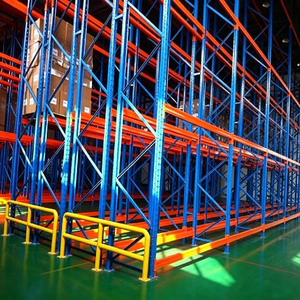
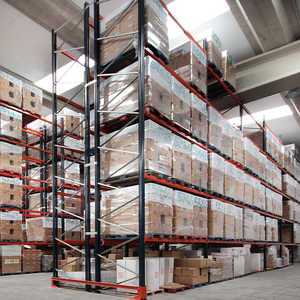
Floor block stacking leaves massive empty spaces when partial SKU lots are retrieved. Engineered dynamic block racking ensures dedicated lanes and automated deep-lane retrieval, maximizing floor utility.
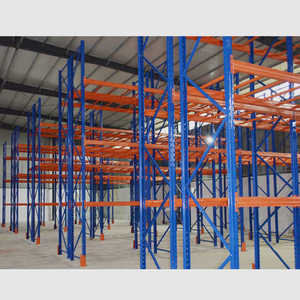
Manufactured using hot-rolled C-channel structural steel (SK3000 series) or closed tubular boltless sections (SK2000 series) to withstand continuous heavy forklift impact without column buckling.
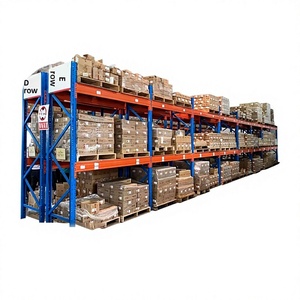
Fully compliant with California ASCE 7 and RMI ANSI MH16.1 standards. Designed with heavy-duty base plates, enlarged seismic anchors, and structural bracing tailored to San Francisco fault lines.
To understand why modern Bay Area distribution centers are replacing floor stacking with factory-engineered racking systems, logistics managers must evaluate the physics of vertical storage. Floor block stacking relies entirely on the packaging strength of the underlying product (such as corrugated boxes or wooden crates). Under sustained vertical load, bottom packaging suffers from fatigue creep, causing stack leaning, product crushing, and hazardous warehouse environments.
FlexBeam’s block stacking racking systems transfer all vertical and horizontal forces directly into heavy-gauge steel structural columns anchored into the concrete floor slab. Whether utilizing closed-section tubular uprights or structural channel steel, the weight of upper pallets never touches the lower goods. This fundamental engineering shift allows operations to stack 4, 6, or even 8 pallets high vertically (up to 40 feet clear height), unlocking tens of thousands of cubic feet of previously unusable warehouse overhead.
| Storage Methodology | Pallet Utilization (%) | Honeycombing Loss | Seismic Rating (CA Code) | Product Crushing Risk | Optimal SKU Profile |
|---|---|---|---|---|---|
| Traditional Floor Block Stacking | 35% – 45% | High (>50%) | Uncontrolled / Non-compliant | Severe / High Cost | Low-value bulk, rigid items |
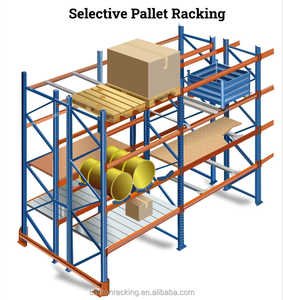
| Selective Pallet Racking | 90% – 100% | Very Low (<5%) | Fully Certified | Zero (Rack Supported) | High SKU diversity, low volume per SKU |
| Drive-In Block Racking | 75% – 85% | Moderate (15% - 25%) | Engineered Heavy Bracing | Zero (Rack Supported) | High volume, few SKUs, LIFO rotation |
| Pushback / Pallet Flow Racking | 85% – 92% | Low (<10%) | Seismic Dynamic Dampened | Zero (Rack Supported) | Medium-to-high velocity SKUs, FIFO/LIFO |
| 4-Way Radio Shuttle Block System | 90% – 98% | Negligible (<3%) | Advanced Finite Element (FEA) | Zero (Automated Carriage) | Cold storage, high-cube e-commerce & 3PL |
San Francisco and its surrounding metropolitan industrial zones present distinct operational challenges driven by micro-climates, strict municipal building codes, high labor costs, and diverse industry verticals. FlexBeam custom engineers block racking configurations for specific Bay Area application scenarios:
Temperature-controlled warehousing along South SF and Brisbane requires maximum pallet density due to immense energy overhead per cubic foot. Our structural steel Drive-In and Radio Shuttle systems operate flawlessly down to -30°C (-22°F), resisting thermal contraction fatigue while eliminating lost cold space.
High-turnover container freight stations near the Port of Oakland require rugged racking that tolerates high-velocity forklift operations. FlexBeam’s SK2000 boltless tubular racking features closed structural upright columns that exhibit up to 250% higher torsional stiffness than open roll-formed racks.
In San Jose, Santa Clara, and Fremont, technology manufacturers require precision storage for sensitive electronic components, cleanroom supplies, and heavy raw materials. Our anti-static powder coatings, heavy-duty wire decking, and rigid structural frames provide dust-free, non-combustible storage safety.
Installing high-density block racking in San Francisco requires strict adherence to local regulatory oversight. The San Francisco Department of Building Inspection (DBI) and the San Francisco Fire Department (SFFD) strictly regulate high-pile stock storage (storage exceeding 12 feet in height). Facilities must present stamped engineering calculations verified by a California-licensed Structural Engineer (SE).
Because the Bay Area is located directly along the San Andreas and Hayward fault zones (categorized under Seismic Design Categories D, E, and F), racking systems must be calculated for peak ground acceleration forces (SDS values often exceeding 1.5g). FlexBeam designs all export structural rack systems with heavy-gauge enlarged footplates, multi-anchor bolt patterns, structural horizontal channel bracing, and heavy-duty beam-to-column locking mechanisms. Every system exported to California includes full structural calculations, Finite Element Analysis (FEA) modeling, and certified steel mill test reports to ensure seamless permit approval by local Authorities Having Jurisdiction (AHJ).
As a specialized international rack factory and direct exporter, FlexBeam bridges the gap between cost-effective overseas manufacturing and stringent North American engineering specifications. We eliminate middleman markups while enforcing rigorous quality control at every stage of production:
We source structural Q235B and Q355B (equivalent to ASTM A36 and ASTM A572 Grade 50) steel coils and hot-rolled channels, ensuring superior yield strength, ductility, and cold-temperature impact resistance.
All upright frame bracing and beam connector plates are welded using automated robotic arms to ensure deep weld penetration, flawless bead consistency, and zero stress concentration points.
Uprights and beams are systematically bundled with heavy steel banding, corner edge protectors, and waterproof plastic shrink wrap to eliminate chafing, moisture oxidation, and transit damage during ocean container transport to the Port of Oakland.
Standard floor block stacking results in honeycombing space waste, product crushing, and strict height limitations under Cal/OSHA regulations. Engineered block stacking racking systems (such as Drive-In, Pushback, or Radio Shuttle systems) utilize vertical warehouse space up to 40 feet high without exerting any weight on lower pallets, doubling or tripling storage capacity while protecting inventory integrity.
Yes. All FlexBeam industrial racking systems exported to California are engineered in reference to ANSI MH16.1 (RMI), ASCE 7, and the California Building Code (CBC). We provide complete component load ratings, CAD layout drawings, structural steel specifications, and Finite Element Analysis (FEA) data required for stamped approval by California-licensed PE/SE structural engineers.
SK2000 utilizes closed-section tubular upright columns that offer exceptional impact resistance and fast, boltless beam adjustments, making it ideal for high-traffic selective storage. SK3000 uses heavy hot-rolled structural steel C-channels bolted together, making it the premier choice for extreme heavy-duty loads, high-cube drive-in block racking, freezer/cold storage, and high-impact forklift environments.
Orders are factory-packed into 40-foot high-cube ocean containers and shipped directly to the Port of Oakland. From the port, drayage trucks deliver the bundled components straight to your job site in San Francisco, South SF, Oakland, San Jose, or surrounding Northern California industrial districts.
To provide an optimized engineering layout, we require: (1) Pallet dimensions (W x D x H) and maximum gross weight per pallet, (2) Clear height of the warehouse ceiling and sprinkler drop clearance, (3) Forklift model, lift height, and operating aisle width, (4) Concrete floor slab thickness and compressive strength, and (5) Inventory management preference (FIFO vs. LIFO).
Automated 4-Way Radio Shuttle racking and deep-lane Drive-In racking offer the highest spatial density (up to 85%-95% footprint utilization). Radio Shuttle systems are particularly popular in Bay Area cold storage centers because they eliminate forklift drive-in aisles, reducing operating cycle times and thermal heat loss.
Contact FlexBeam's engineering team today for a complimentary warehouse space audit, custom CAD layout design, and competitive direct-factory pricing for your Bay Area facility.