Executive Whitepaper: Industrial Pallet Racking Structural Engineering & Global Procurement
In modern logistics, warehousing, and automated distribution, structural bulk storage pallet racking represents the foundational capital asset of supply chain infrastructure. Selecting qualified pallet racking manufacturers and direct-to-factory suppliers is no longer merely a routine purchasing exercise; it is a critical engineering decision that dictates warehouse volumetric efficiency, operational throughput, workplace safety, and multi-decade Total Cost of Ownership (TCO).
As global supply chains shift toward automated intra-logistics, high-bay storage, and cold-chain consolidation, industrial procurement teams must navigate complex structural engineering metrics, international building code compliance, seismic engineering calculations, and metallurgical material grades. This engineering whitepaper outlines the structural parameters, advanced design typologies, and future procurement strategies required for enterprise buyers evaluating heavy-duty storage systems.
Information Gain Key Takeaway: Frame Buckling & Sectional Rigidity
Not all steel racking profiles are structurally equivalent. While standard open cold-roll C-channel uprights are cost-effective for standard retail environments, high-throughput industrial facilities require closed tubular sections (such as FlexBeam SK2000® technology) or heavy hot-rolled structural steel channel columns (SK3000®). Tubular closed-section uprights exhibit up to 250% greater torsional resistance and superior forklift impact absorption, substantially mitigating progressive rack collapse risks.
Enterprise Factory Advantage: Manufacturing Rigor & International Compliance
As a premier bulk storage pallet racking manufacturer, our facility integrates state-of-the-art automated continuous roll-forming lines, robotic MIG welding cells, and eco-friendly electrostatic powder-coating systems. To guarantee structural safety under maximum loaded conditions, raw material selection is strictly controlled.
1. Metallurgical Steel Grades & Structural Integrity
We utilize high-yield structural carbon steel grades, specifically Q235B and Q355B (equivalent to ASTM A1011 SS Grade 50 / EN 10025 S355). Steel coils undergo rigorous tensile testing, yield strength verification, and dimensional tolerance checks prior to roll forming. The high yield strength of Q355B steel allows for higher frame capacity ratings without adding unnecessary dead weight to the warehouse slab foundation.
2. Structural Design Standards Compliance Matrix
Global racking projects require engineering compliance with localized civil and structural design codes. Systems engineered in our factories adhere strictly to international rack design standards:
| Standard / Code |
Jurisdiction |
Key Engineering Focus & Testing Methodology |
| ANSI MH16.1 (RMI) |
North America / USA |
Specification for the Design, Testing and Utilization of Industrial Steel Storage Racks. Focuses on frame stability, beam-column connector rigidity, and perforated column capacity checks. |
| EN 15512 / EN 15635 |
European Union / UK |
Steel static storage systems – Adjustable pallet racking systems. Mandates finite element analysis (FEA), global and local safety factors, and strict limit state design principles. |
| AS 4084:2023 |
Australia / New Zealand |
Steel storage racking specification covering structural design, installation tolerances, and high seismic dynamic sway analysis for Pacific rim regions. |
| ISO 9001:2015 |
Global Factory Certification |
Quality management system governing continuous weld quality inspections, powder coat cross-hatch adhesion testing, and dimensional tolerance control. |
Comparative Analysis of Heavy-Duty Bulk Storage Architectures
Selecting the optimal pallet racking configuration requires balancing Storage Density (Cubic Utilization) against Pallet Selectivity (Direct SKU Access). Procurement teams must match inventory rotation requirements—First-In, First-Out (FIFO) vs. Last-In, First-Out (LIFO)—with appropriate rack structural profiles.
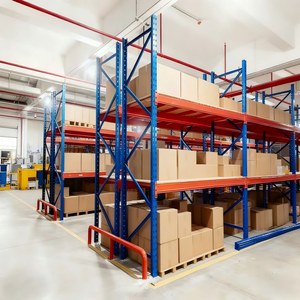
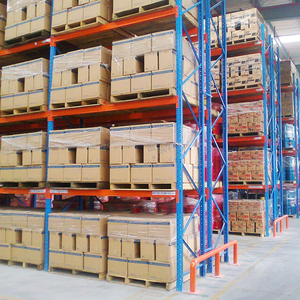
Selective Pallet Racking
Selectivity: 100% | Density: Medium
Direct access to every pallet position. Ideal for high-SKU inventory, distribution centers with varied order profiles, and fast-moving consumer goods (FMCG).
Push Back Cart Racking
Selectivity: ~30% | Density: Very High
LIFO dynamic storage using nested carts riding on inclined structural rails. Stores 2 to 6 pallets deep per lane while preventing forklift aisle entry.
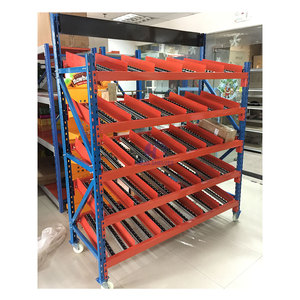
Pallet Gravity Flow Racks
Selectivity: High | Density: High (FIFO)
Gravity-driven roller tracks with internal speed controllers and safety separators. Perfect for date-sensitive food, beverage, and pharmaceutical storage.
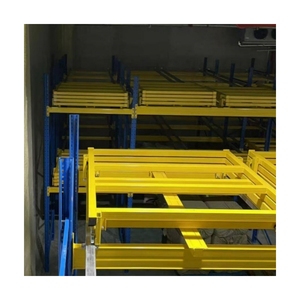
Drive-In / Drive-Thru Racks
Selectivity: Low | Density: Maximum
Eliminates operating aisles. Forklifts enter continuous storage bays. Highly economic solution for cold storage facilities handling batch manufacturing SKUs.
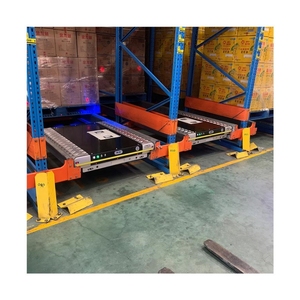
AS/RS Automated Shuttle Racking
Selectivity: Automated | Density: Ultra High
Engineered to ultra-tight millimetric tolerances for 4-way radio shuttles and automated crane retrievals. Designed for smart 24/7 unassisted fulfillment.
Structural Work Platforms & Mezzanines
Space Expansion: +100% Floor Area
Heavy-duty elevated structural steel platforms utilizing unutilized overhead vertical room for order picking modules, offices, and conveyor routing.
Future Procurement & Technological Trends in Storage Manufacturing
As logistics real estate costs escalate globally, the bulk storage market is experiencing rapid technological evolution. B2B buyers must specify structural storage solutions that are future-proofed for next-generation automation and sustainability targets.
1. Integration of IoT Load & Impact Sensor Telematics
Smart racking systems are transitioning from passive steel frames to active data nodes. Modern enterprise factories now incorporate integrated structural strain gauges and wireless impact sensors within bottom upright columns. These sensors record forklift collision severity and alert facility engineers to structural overloading or hidden frame displacement before catastrophic failure occurs.
2. Cold-Rolled vs. Hot-Rolled Structural Channel Hybridization
While roll-formed teardrop racking dominated historic installations due to low shipping weight, global logistics providers are increasingly mandating hybrid systems. High-impact lower zones (first 1.5 meters) are reinforced with hot-rolled structural C-channel steel (SK3000® standards) or heavy-gauge column guards, while upper elevation levels utilize high-tensile boltless tubular beams to optimize steel weight and cost.
3. Carbon Neutrality & Environmental Product Declarations (EPD)
European and North American sustainability directives now require industrial manufacturers to provide Environmental Product Declarations (EPD) for structural steel products. Leading factories utilize low-carbon electric arc furnace (EAF) recycled steel scrap, green hydrogen-annealed raw coils, and solvent-free zero-VOC powder-coating lines to minimize the embedded carbon footprint of warehouse racking projects.
4. Modular Reconfigurability for 3PL Dynamic Contracts
Third-Party Logistics (3PL) providers operating on 3-to-5-year client contracts require racking systems that can be rapidly dismantled, reconfigured, or expanded without structural welding. Boltless teardrop beam connections and toolless heavy-duty locking pins allow rapid pitch adjustments (in 50mm or 75mm increments) to accommodate evolving pallet height profiles.
Procurement Roadmap: Critical Data Required for Factory Engineering
To receive a structurally stamped CAD floor plan, load calculation documentation, and competitive factory quotation, procurement teams should prepare the following key parameters for factory design engineers:
| Pallet Specifications: Pallet dimensions (Width x Depth x Height including cargo overhang), gross weight per pallet, and pallet entry side (bottom runner direction). |
Facility Architectural Data: Building clear height, overhead sprinkler/lighting clearance, floor slab thickness, concrete compressive strength (PSI/MPa), and soil bearing capacity. |
Material Handling Equipment (MHE): Forklift type (Counterbalance, Reach Truck, VNA Turret Truck), minimum aisle turnaround width requirements, maximum lift height, and mast collapsed height. |
Environmental & Seismic Factors: Operating temperature range (Ambient, Cool Room, or -30°C Freezing), regional seismic Zone factor (Z-factor), and soil site class code. |
Custom OEM/ODM Engineering Capabilities
Have an unconventional warehouse footprint or non-standard heavy equipment loads? Our structural engineering department provides bespoke 3D CAD modeling, Finite Element Analysis (FEA) stress testing, and custom color-matched powder coat finishes for global enterprise clients.