


Precision-engineered, load-tested heavy-duty pallet racking systems designed for automotive stamping dies, engine components, sub-assemblies, and high-velocity spare parts fulfillment.
The global automotive supply chain operates on strict Just-In-Time (JIT) and Just-In-Sequence (JIS) principles. Any failure within a manufacturing plant's storage infrastructure risks cascading downtime costing tens of thousands of dollars per hour. As a premier automotive parts pallet racking supplier and global exporter, FlexBeam Warehouse Equipment engineers high-capacity, impact-resistant industrial pallet storage systems designed explicitly to withstand the intense physical demands of OEM assembly lines, stamping facilities, and Tier-1 distribution centers.
Automotive storage requirements differ fundamentally from standard FMCG warehousing. Automotive loads frequently involve heavy metal stillages, engine blocks, transmission assemblies, body-in-white (BIW) stampings, and dense EV battery packs. Standard open roll-formed racking profiles often suffer progressive structural deformation when subjected to repeated forklift impacts and concentrated live loads. Our engineering philosophy centers on structural integrity, material selection, and rigorous design validation against international standards including ANSI MH16.1 (RMI), EN 15512, and AS 4084.
Technical Insight: Closed Tubular vs. Open C-Channel Uprights
FlexBeam's flagship SK2000 boltless closed-section tubular uprights provide up to 250% greater torsional rigidity and 44-times higher resistance to forklift impact forces compared to conventional open-back roll-formed columns. This dramatically lowers long-term facility maintenance costs and prevents rack collapse accidents.
To deliver uncompromising load capacities ranging from 800kg to over 3,000kg per pallet level, our heavy-duty industrial racking systems utilize cold-rolled high-yield steel (Q355B grade) and hot-rolled structural steel channels (SK3000 series). Every frame and beam configuration undergoes Finite Element Analysis (FEA) to verify stress distribution, safety factors, and deflection thresholds under full design load.
Compare structural capabilities, density efficiency, and operational suitability across primary automotive racking architectures.
| Racking Architecture | Storage Density | SKU Selectivity | Load Capacity / Level | Operational Flow | Primary Automotive Application |
|---|---|---|---|---|---|
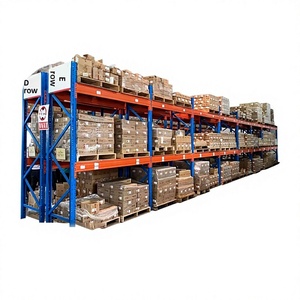
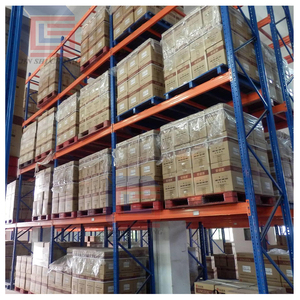
| Selective Pallet Racking | Medium (50%) | 100% Direct Access | 1,000 kg – 4,000 kg | FIFO / LIFO | Aftermarket parts, mixed SKU fulfillment, Tier-1 distribution hubs. |
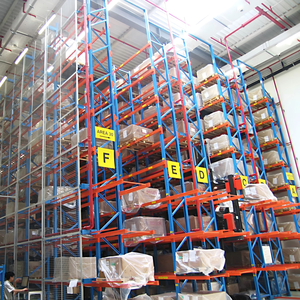
| VNA Very Narrow Aisle | High (75%) | 100% Direct Access | 800 kg – 3,000 kg | FIFO / LIFO | High-density buffer storage for assembly line components. |
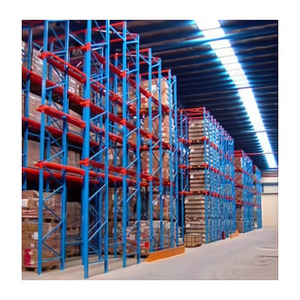
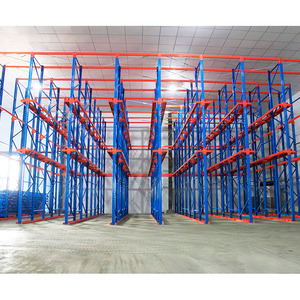
| Drive-In / Drive-Through | Very High (85%) | Low (Bulk SKUs) | 1,000 kg – 2,500 kg | LIFO (Drive-In) / FIFO | High-volume uniform parts, stamping dies, body panels. |
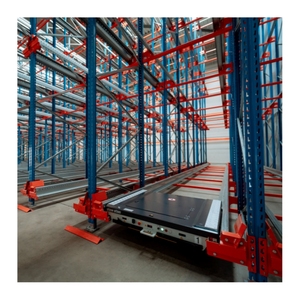
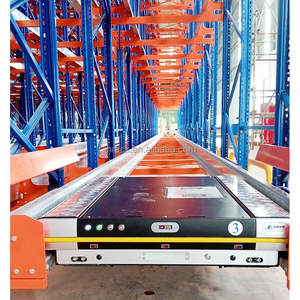
| Radio Shuttle System | Maximum (90%+) | Medium-Low | 1,500 kg – 2,500 kg | Automated FIFO/LIFO | EV battery module staging, engine block cold storage, fast-velocity lines. |
| Pushback Racking | High (70%) | Medium per Lane | 1,000 kg – 2,000 kg | LIFO (2-6 Deep) | Buffer storage between press shop and body assembly lines. |
| Heavy-Duty Cantilever | Flexible | 100% Linear Access | 1,000 kg – 6,000 kg+ | Direct Access | Automotive exhaust pipes, driveshafts, extruded aluminum, bar stock. |
As the global automotive industry undergoes a seismic shift toward Electric Vehicles (EVs), autonomous mobility, and Industry 4.0 smart factories, warehouse infrastructure procurement strategies are evolving rapidly. Supply chain directors and procurement executives can no longer evaluate pallet racking purely on initial capital expenditure per pallet position. Instead, modern procurement focuses on total cost of ownership (TCO), flexible modularity, automation compatibility, and environmental sustainability.
With rising labor costs and the need for zero-error inventory tracking, automotive manufacturing plants are replacing static high-density systems (such as traditional drive-in rack) with radio shuttle racking and AS/RS (Automated Storage and Retrieval Systems). Radio shuttle systems allow automated carts to navigate deep storage channels, drastically reducing forklift travel time and warehouse collision risks. Future-proof pallet racking designs must incorporate precision-engineered rails, sensors, and structural tolerances capable of accommodating autonomous shuttles and AGVs (Automated Guided Vehicles).
EV battery packs present unique storage challenges due to their heavy weight, strict fire safety compliance, and thermal management requirements. Standard pallet racks are often inadequate for multi-ton battery modules. Global procurement trends show a rapid increase in demand for structural channel racks with integrated heavy-duty drop-in wire decking, flame-retardant containment barriers, and specialized grounding systems to safely store lithium-ion battery modules during aging and assembly staging.
Automotive vehicle production platforms typically undergo redesign cycles every 5 to 7 years. Fixed storage infrastructure creates significant write-off risks when part dimensions change. Leading automotive procurement managers now insist on modular, boltless racking systems (such as FlexBeam's SK2000 series) that can be easily reconfigured, height-adjusted, or expanded without structural cutting or welding. Additionally, manufacturers prioritize suppliers utilizing fully recyclable steel and low-emission powder coating processes to meet corporate ESG (Environmental, Social, and Governance) targets.
To eliminate unexpected rack structural collapses, Tier-1 automotive facilities are piloting smart racking systems equipped with strain gauges, impact sensors, and IoT monitoring modules. These connected devices alert warehouse managers immediately when a forklift impact exceeds critical structural thresholds, allowing for proactive component replacement before catastrophic failure occurs.
The global automotive logistics landscape is experiencing profound transformations driven by supply chain resilience strategies, nearshoring, and hyper-localized manufacturing hubs. Understanding these macro trends enables industrial engineering teams to design warehouse storage solutions that remain productive over decades.
Recent global supply chain disruptions have led major automotive OEMs to move away from single-source offshore inventory models toward "Just-in-Case" regionalized buffer storage. Overseas suppliers must now maintain substantial buffer stock within destination markets. This shift has fueled massive growth in demand for high-rise pallet racking installations across 3PL warehouses supporting North American, European, and Southeast Asian automotive corridors.
Because industrial land prices near urban assembly plants continue to escalate, automotive suppliers must maximize vertical volume rather than building larger horizontal footprints. Very Narrow Aisle (VNA) pallet racking systems and multi-tier structural pick modules allow facilities to reach ceiling clear heights of 15 to 25 meters, increasing effective pallet density by up to 80% over standard selective layouts.
Enterprise Advantage: Global Export & Turnkey Engineering Support
FlexBeam Warehouse Equipment provides end-to-end export support for overseas projects. From initial CAD layout engineering and structural calculations to container loading optimization, component coding, and installation support, we ensure your international racking deployment is executed on schedule and fully compliant with local building codes.
Frequently asked questions by global procurement officers, project engineers, and warehouse operations managers.