


Direct from China's leading automated OEM manufacturing lines. High-density, load-certified storage equipment engineered to international safety standards.
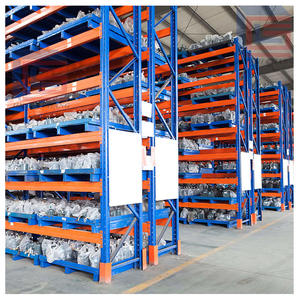
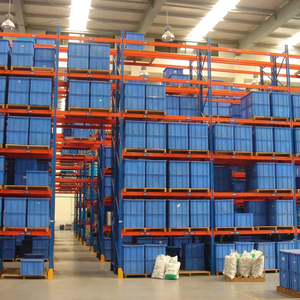
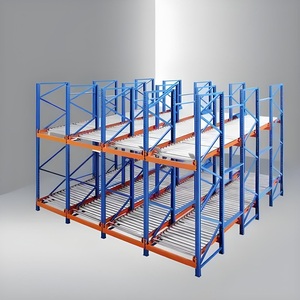
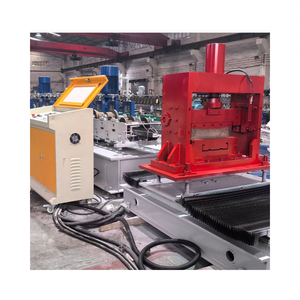
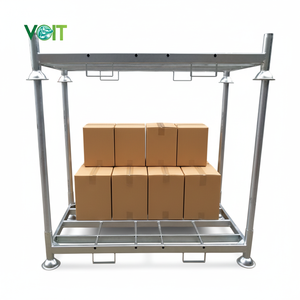
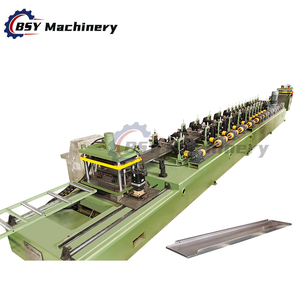
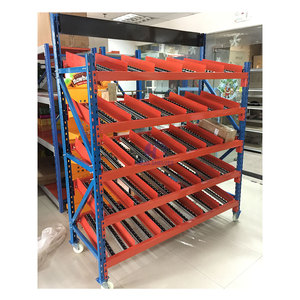
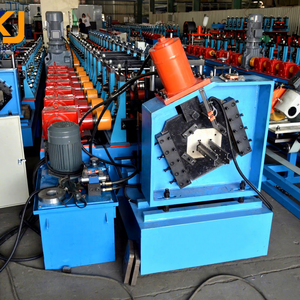
In modern industrial logistics, selecting between cold-rolled, roll-formed pallet racking and heavy-duty structural channel racking represents a critical capital investment decision. Roll-formed steel racking—manufactured by continuously feeding high-tensile cold-rolled steel coils through multi-stage precision roll-forming machine lines—offers an unparalleled strength-to-weight ratio, exceptional modular flexibility, and highly cost-effective shipment economics.
The core structural integrity of roll-formed upright frames relies on complex section profiles, such as the open-C profile, teardrop, and closed tubular designs (e.g., SK2000 style closed sections). Multi-stage cold roll forming introduces work hardening into steel, elevating local yield stress at corners while creating stiffening ribs and return flanges. These features significantly boost moment of inertia ($I_x, I_y$) and torsional rigidity without increasing dead weight.
| Engineering Attribute | Roll-Formed Pallet Racking | Hot-Rolled Structural Racking | Engineering Advantage |
|---|---|---|---|
| Steel Grade & Yield Strength | Q235B to Q355B Cold-Rolled Steel (Yield $\ge 355 \text{ MPa}$) | Hot-Rolled Structural Channels (Yield $\approx 235 \text{ MPa}$) | Roll-formed high-tensile steel delivers 20-30% lighter structural weight for identical payload capacity. |
| Adjustability & Assembly | Boltless tear-drop / hook-in beam connectors with safety locks | Bolted beam-to-frame connections requiring manual torqueing | Roll-formed systems reduce installation labor hours by over 60% with instant beam height adjustments (50mm/75mm pitch). |
| Torsional Resistance & Deflection | Optimized profile geometry with continuous ribbing ($L/180$ limit) | Solid flange resistance, heavy rigid channel profiles | Advanced roll-formed closed tubular profiles match structural impact resistance at a lower raw material cost. |
| Freight & Export Logistics | High-density nested bundle packing (up to 26 Tons per 40HQ) | Bulky non-nesting structural steel sections | Reduces ocean shipping cost per pallet position by 35%, maximizing container CBM yield. |
| Seismic Performance ($R_p$) | High ductility; dynamic energy dissipation through connections | Rigid frame connections transferring shear forces directly to slab anchors | Roll-formed racking dynamically flexing under seismic acceleration, mitigating catastrophic structural shear failure. |
For high-throughput distribution centers, cold-chain freezers, and automated material handling facilities, roll-formed rack systems provide the optimal balance between initial Capex, operational adaptability, and structural compliance under standards like ANSI MH16.1 (RMI), FEM 10.2.02, EN 15512, and AS 4084-2012.
Why Tier-1 global logistics operators and equipment distributors partner with top China roll-forming OEM manufacturers.
Our manufacturing complex houses high-precision, motor-driven automated roll-forming lines integrated with real-time PLC optical sensors. This guarantees pitch hole tolerances within $\pm 0.2\text{mm}$ across 12-meter upright columns, ensuring effortless job-site assembly and beam alignment.
Every racking layout is validated via Finite Element Analysis (FEA) software to simulate live rack payloads, seismic ground motion, and fork truck impacts. Our quality assurance team executes raw material tensile testing, weld non-destructive testing (NDT), and salt spray corrosion testing (ASTM B117 > 500 hrs).
With certifications including CE, ISO 9001, ISO 14001, and full compliance with RMI (ANSI MH16.1) guidelines, we export complete racking packages—uprights, step beams, wire decking, pallet flow rails, and safety column guards—with fully custom export-flat bundling.
The global warehousing and material handling market is shifting toward automated, high-density, and energy-conscious infrastructure. As smart warehousing expands, China's leading roll-formed pallet racking manufacturers are innovating across four critical engineering dimensions:
Roll-formed profiles engineered to ultra-tight tolerances ($\pm 1.0\text{mm}$ frame plumbness) required by high-speed Automated Storage & Retrieval System (AS/RS) cranes and 4-way pallet shuttles.
Transitioning from traditional Q235 steel to High-Strength Low-Alloy (HSLA) Q355B and Q420 steel coils, reducing material mass by up to 20% while increasing total beam load capacity.
Embedding strain gauge sensors and micro-tilt meters directly inside roll-formed upright columns for continuous health monitoring, detecting overload deformation and forklift collision hazards in real-time.
Adopting zero-VOC electrostatic powder coatings and continuous hot-dip galvanizing lines designed for harsh sub-zero cold storage environments down to $-30^\circ\text{C}$ without brittle fracture risks.
Procurement directors and supply chain managers are evolving their sourcing strategies to hedge against ocean freight fluctuations, raw steel price volatility, and stringent local building codes. When negotiating OEM manufacturing contracts with Chinese suppliers, international buyers are focusing on three primary structural models:
Essential answers for structural engineers, project managers, and equipment buyers importing roll-formed racking from China.
Roll-formed pallet racking is manufactured from cold-rolled steel coils formed into open or tubular profiles using continuous rollers. It features boltless teardrop or hook connectors for quick assembly and adjustment. Structural racking is made from hot-rolled structural steel channels bolted together, offering extreme resistance to heavy forklift impacts at a higher weight and cost.
Top Chinese exporters engineer pallet racking in full compliance with recognized international standards, including ANSI MH16.1 (Rack Manufacturers Institute - RMI) for North America, FEM 10.2.02 and EN 15512 for Europe, and AS 4084-2012 for Australia and New Zealand. Always request engineering load capacity calculations tailored to your local building code and seismic zone.
To prepare an optimized layout and capacity calculation, provide your building CAD drawing (showing clear height, floor slab thickness, column grid, and door locations), pallet dimensions ($W \times D \times H$), gross load weight per pallet, forklift type (reach truck, counterbalanced, VNA), operating aisle clearance, and working environment temperature.
Upright frames and load beams are strapped into heavy-duty wooden-skid bundles with plastic wrapping and edge corner protectors. Small components, safety clips, baseplates, and row spacers are packed into reinforced wooden crates or corrugated cartons on pallets to eliminate metal-on-metal abrasion and prevent transit damage during long sea voyages.
Under international standard engineering practices (ANSI MH16.1 / FEM 10.2.02), maximum allowable beam deflection under full static load must not exceed $L/180$, where $L$ is the clear span length of the beam. For example, a 2700mm beam under maximum rating can deflect a maximum of 15mm without exceeding structural elastic yield thresholds.
Connect with our expert application engineers to design your high-density storage layout, receive certified FEA load reports, and get factory-direct wholesale pricing.
Get a Quote