


Engineered to structural standards (ANSI MH16.1, FEM 10.2.02, EN 15512) for cold storage, 3PL hubs, automated distribution centers, and heavy industrial manufacturing.
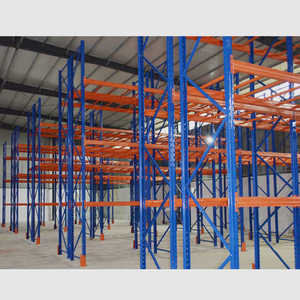
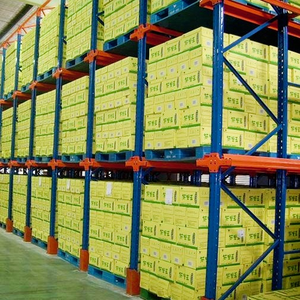
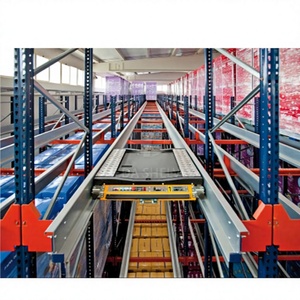
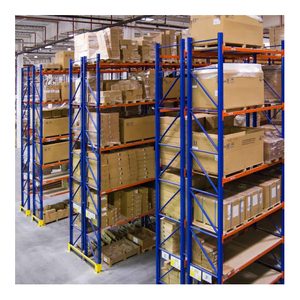
In modern industrial supply chain management, floor space optimization is directly correlated with operational yield per square meter. As real estate procurement and warehouse heating/cooling overheads rise globally, international logistics directors are shifting from single-selective pallet racking (which utilizes only 35%–40% of net warehouse floor space) to advanced Multi-Deep High-Density Pallet Racking Systems.
China has established itself as the world’s manufacturing powerhouse for heavy-duty storage infrastructure, housing specialized OEM/ODM export facilities equipped with ultra-precise PLC cold roll-forming lines, automated robotic gas metal arc welding (GMAW), and electro-static thermosetting epoxy powder coating lines. Top Chinese structural racking exporters supply systems capable of maximizing floor area utilization up to 75%–85% while satisfying rigorous international structural standards including ANSI MH16.1 (Rack Manufacturers Institute - RMI), EN 15512 (European Committee for Standardization), and AS 4084 (Australian Standard for Steel Storage Racking).
Primary Chinese manufacturing lines utilize high-grade certified structural steel. High-yield carbon steel coils (Q235B and Q355B grade, equivalent to ASTM A1011 SS Grade 36 and Grade 50) are roll-formed into closed tubular profiles or continuous perforated C-channel upright posts. The cold-forming process work-hardens the steel, increasing nominal yield strength ($f_y$) and ultimate tensile strength ($f_u$).
Evaluating multi-deep systems requires balancing volumetric efficiency against direct access speed (selectivity). Below is an engineering comparison matrix specified by leading Chinese exporters for global procurement teams:
| Storage Modality | Depth Capacity | Rotation Method | Volumetric Efficiency | Selectivity Ratio | Optimal Application |
|---|---|---|---|---|---|
| Double-Deep Selective | 2 Pallets Deep | LIFO | 60% – 65% | 50% Direct Access | Medium SKU volume, paired batch manufacturing |
| Push-Back Cart System | 2 to 6 Pallets Deep | LIFO | 70% – 75% | 1 Load Face / Lane | Medium-velocity distribution, multi-lane staging |
| Drive-In / Drive-Through | 4 to 10+ Pallets Deep | LIFO / FIFO | 75% – 80% | Low (Per Lane) | Homogeneous bulk items, seasonal raw materials |
| Radio / 4-Way Shuttle | Up to 40+ Pallets Deep | FIFO or LIFO | 85% – 90% | Automated Lane-Level | Cold storage (-30°C), high-throughput FMCG hubs |
Utilizes specialized pantograph reach trucks or deep-reach fork attachments. Reduces aisle count by 50% compared to standard selective racking, delivering an immediate 30% increase in storage capacity.
Gravity-assisted nested carts ride on inclined structural steel rails ($2^\circ\text{ to }3^\circ$ incline). When a front pallet is unloaded, rear pallets smoothly push forward automatically without forklift entry.
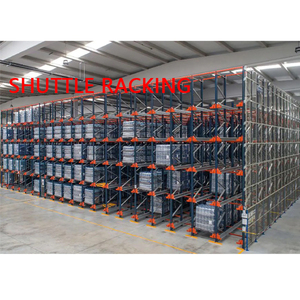
Self-powered lithium battery shuttles traverse inner racking channels via Wi-Fi/5G signals. Integrates seamlessly with WMS/WCS for ultra-high-density automated storage and retrieval (ASRS).
Leading Chinese racking manufacturers combine large-scale raw material sourcing from tier-1 steel mills (Baosteel, Shougang Group) with advanced engineering customization. Original site engineering frameworks—such as boltless tubular structural profiles (SK2000 series) and heavy structural channel configurations (SK3000 series)—ensure long-term durability under heavy industrial impact.
As global supply chains adopt Industry 4.0 automation, multi-deep pallet storage infrastructure is undergoing rapid technological evolution. Global buyers should evaluate these upcoming procurement trends:
Traditional fixed-aisle crane systems (ASRS) are being superseded by flexible 4-Way Radio Pallet Shuttles integrated with vertical lift elevators. Shuttles automatically switch channels along both $X$ and $Y$ axes, removing single-point crane failure risks and enabling dynamic scaling during peak seasonal demand.
With the expansion of global pharmaceutical, frozen food, and bio-logistics distribution, cold room racking (-25°C to -30°C) demands specialized micro-alloyed steels. Silicon-killed fine-grain structural steels treated with low-temperature impact testing (Charpy V-Notch impact resistance at -40°C) prevent low-temperature hydrogen embrittlement and catastrophic dynamic failure.
Next-generation multi-deep installations integrate strain gauges and piezoelectric shock sensors into critical upright bases. Real-time telemetry alerts facility directors to structural overload, excessive beam deflection, or unrecorded forklift impact collisions before structural fatigue occurs.
International environmental regulations require fully recyclable storage hardware. Export factories in China are transitioning toward eco-friendly hot-dip zinc-aluminum-magnesium (ZAM) coatings and low-emission powder coatings, offering superior self-healing edge corrosion protection without environmental contamination.
To generate precise structural drawings and load rating calculations, buyers must provide: (1) Pallet footprint dimensions ($W \times D \times H$) including maximum load weight, (2) Building clear height to lowest ceiling obstruction/sprinkler line, (3) Forklift specifications (minimum aisle width, maximum lift height, mast reach depth), (4) Concrete floor slab thickness and strength grade (e.g., 200mm C30 concrete), and (5) Local seismic zone acceleration coefficients ($S_s, S_1$).
Double-Deep racking has a significantly lower initial capital expenditure (CapEx) because it uses static steel frames and standard deep-reach forklifts. However, Radio Shuttle racking delivers much higher storage density (storing 15 to 40+ pallets deep per lane), eliminates forklift entry risks into lanes, reduces labor cycle times by up to 50%, and provides superior long-term Return on Investment (ROI) for high-throughput or cold-storage environments.
Premier Chinese racking factories design, engineer, and manufacture systems conforming to major global standards: ANSI MH16.1 (RMI standard widely used in North America), EN 15512 / FEM 10.2.02 (European structural standards), and AS 4084 (Australian steel storage racking code). Verified factories supply certified mill test report (MTR) documentation, CE compliance marks, and ISO 9001:2015 quality control certificates.
Upright frames and box beams are bundled in custom heavy-duty steel strapping with protective corner edge guards, plastic film wrapping, and wooden skids. Small structural accessories (baseplates, safety pins, beam connectors, bolts) are packed in heavy-duty wooden crates or steel-banded corrugated cartons labeled with component IDs to streamline container unloading and field installation.
Yes. Engineering teams calculate dynamic seismic base shear and overturn forces using finite element structural software. High seismic zone configurations incorporate heavy-gauge baseplates, enlarged wedge or chemical anchor bolts, structural top-bracing frames, and heavy-duty horizontal/diagonal bracing channels to ensure structural safety during dynamic ground motion.
Work directly with certified structural racking engineers to optimize your warehouse storage capacity. Send us your floorplan CAD files and load requirements today.
Get Catalog