


Explore our factory-direct OEM/ODM structural and selective racking inventory, engineered to ANSI MH16.1 and EN 15512 standards for maximum structural payload safety.
Quantitative metrics backing our multi-level pallet rack production line and international project execution.
Understanding the physics of vertical space optimization, column stability, dynamic payload management, and seismic response modeling.
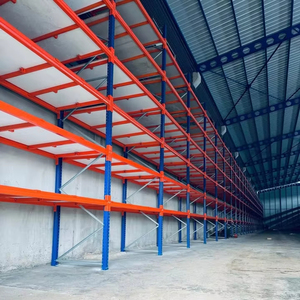
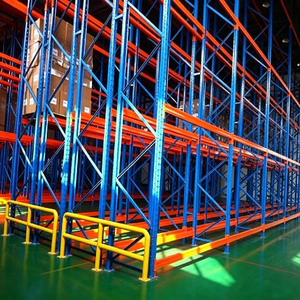
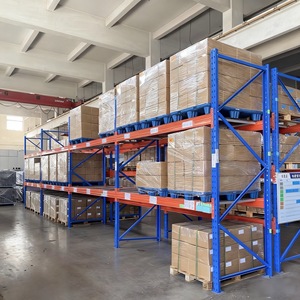
In modern industrial logistics, static floor space is a bottleneck. Vertically expanding logistics facilities using multi-level pallet racking systems requires strict structural engineering compliance. As a dedicated OEM/ODM manufacturer, our engineering framework integrates cold-formed structural steel profiles (Q235B and high-yield Q345B grade) engineered to absorb both static dead loads and dynamic live loads from high-reach forklifts, autonomous mobile robots (AMRs), and shuttle platforms.
The structural load capacity of a vertical storage framework relies primarily on the section modulus ($Z$) and moment of inertia ($I$) of its upright profiles. Unlike basic roll-formed open C-channels, our closed-tubular and heavy-duty structural channel profiles (such as those engineered in our flagship SK2000 tubular and SK3000 structural hot-rolled lines) feature superior torsional rigidity. This prevents localized buckling under extreme axial load combinations.
Cold-formed steel offers exceptional strength-to-weight ratios for selective and pick-module structures, whereas hot-rolled structural channels (SK3000 series) deliver superior collision impact immunity in heavy industrial and freezer logistics environments.
Using precision-punched teardrop or boltless 3-hook/4-hook connector brackets with automatic safety lock pins, our beam connections achieve rigid rotational stiffness ($K_\theta$), eliminating rack sway under high vertical load displacement.
Every custom structural configuration undergoes computer-simulated FEA stress testing under static loading, seismic zone dynamics (P-Delta effects), and operational fork impacts to guarantee a minimum 1.65 structural safety factor.
Structural stability requires controlling beam deflection. The standard allowable deflection under maximum uniformly distributed load (UDL) is set at $L/240$, where $L$ is the clear span of the horizontal load beam. For automated warehouse systems (AS/RS) and automated pallet shuttle lanes, tighter deflection controls down to $L/300$ or $L/400$ are engineered into our profile specifications to ensure smooth robotic travel and prevent sensor misalignments.
| Racking Architecture | Structural Load Rating | Selectivity Ratio | Storage Density | Optimal OEM Applications |
|---|---|---|---|---|
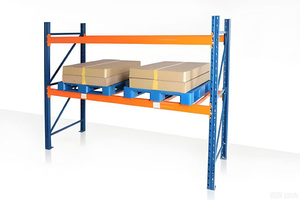
| Selective Pallet Racking | Up to 4,500 kg / beam pair | 100% Direct Access | Moderate (35-40%) | Fulfillment centers, high-SKU distribution, general warehousing. |
| Double-Deep Pallet Rack | Up to 4,000 kg / beam pair | 50% Direct Access | High (50-60%) | Medium-turnover stock, dry storage, cold storage facilities. |
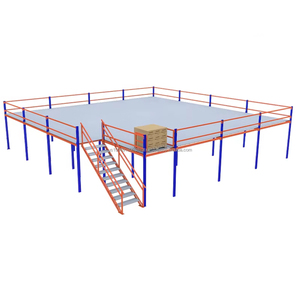
| Multi-Tier Mezzanine Platform | 300 - 1,500 kg / m² deck | 100% Manual Pick Access | Maximized Vertical Utilization | E-commerce order fulfillment, spare parts hubs, multi-level order picking. |
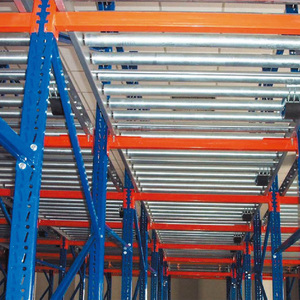
| Gravity Pallet Flow (FIFO) | Up to 1,500 kg / pallet position | Sequential FIFO Access | Ultra-High (75-85%) | Perishable food & beverage, pharmaceuticals, date-coded inventories. |
| Radio Shuttle Automation | Up to 2,000 kg / pallet lane | Automated LIFO / FIFO | Maximum Density (>85%) | Deep-lane cold storage, bulk distribution, high-volume manufacturing. |
Analyzing market developments shifting global enterprise material handling strategies toward modular automation and sustainable steel manufacturing.
Traditional static rack configurations are evolving into hybrid automated frameworks. Modern supply chain projects require customized beam spacing, guided floor rails, and integrated sensor brackets tailored for autonomous mobile robots (AMRs) and automated guided vehicles (AGVs). OEM manufacturers must maintain tight tolerances (±0.5mm) in hole punching and upright alignment to ensure compatibility with optical guidance and automated load handling equipment.
Logistics operators face shifting consumer demand cycles. Rigid, fully welded storage systems are being replaced by modular, boltless multi-level structures. OEM buyers prioritize racking solutions engineered with standard 50mm, 75mm, or 76.2mm pitch adjustments. This flexibility allows facilities to adjust vertical beam levels, integrate pick-module walkways, or convert selective racks into pushback systems without structural modifications.
Intelligent material handling infrastructure incorporates strain gauges and dynamic impact sensors within critical column bases. Real-time telemetry alerts facility safety officers to structural overloads, deflection anomalies, or forklift collisions before structural failures occur. Future OEM specifications will integrate embedded sensor channels directly into cold-rolled upright profiles.
Environmental compliance and ESG metrics drive global supplier selection. Modern racking production uses zero-VOC electrostatic powder coating lines certified to ISO 12944 corrosion resistance classes (C3 to C5 industrial/cold storage). High-efficiency thermosetting epoxy-polyester coatings deliver scratch resistance against heavy forklift use while reducing total lifecycle carbon footprints.
End-to-end engineering, custom structural design, rigorous quality assurance, and export logistics support for international industrial buyers.
Our in-house structural engineering team provides custom 2D floor plans, 3D BIM models, and comprehensive load calculation reports. We engineer systems tailored to your specific pallet footprints, clear building heights, sprinkler line clearances, and floor slab load capacity.
Production follows rigorous ISO 9001 quality management processes. Uprights, frame bracing, load beams, and decking undergo strict dimensional tolerance audits, weld defect ultrasonic checks (AWS D1.1), and salt spray corrosion testing (ASTM B117 500+ hours).
To maximize ocean container utilization and eliminate transit damage, components are steel-strapped into color-coded bundle packages with protective wooden skids. Detailed packing manifests and assembly installation drawings accompany every export shipment.
Clear answers to key technical, structural engineering, and OEM manufacturing questions.
To engineer a compliant multi-level racking system, our engineering team requires: (1) Exact pallet dimensions (Width × Depth × Height) and maximum weight per pallet; (2) Clear building height beneath roof trusses or sprinkler lines; (3) Concrete floor slab thickness, compressive strength (PSI/MPa), and reinforcement grid layout; (4) Forklift specifications, including maximum reach height, operating aisle width, and mast tilt; (5) Local building codes, environmental factors, and seismic zone requirements (RMI / ANSI MH16.1 or EN 15512).
Cold-formed roll-formed racking (such as our SK2000 tubular series) uses sheet steel passed through series of rollers at ambient room temperature, creating lightweight, highly customizable profiles ideal for standard selective and multi-tier pick modules. Hot-rolled structural racking (SK3000 series) uses solid structural steel channels formed at high temperatures. Structural channels offer superior impact resistance against heavy forklift collisions, making them the preferred choice for high-traffic distribution hubs, heavy manufacturing, drive-in systems, and low-temperature cold storage facilities.
For projects located in active seismic zones, our structural engineers execute dynamic modal analyses to calculate lateral force response spectra and horizontal shear forces. We engineer specialized oversized baseplates with heavy-duty anchor bolt embedments, reinforced frame horizontal/diagonal bracing patterns, and high-yield Q345B steel upright profiles to dissipate seismic energy safely while preventing collapse.
For standard dry warehouse environments, electrostatic thermosetting epoxy-polyester powder coating (60–80 microns thick) provides excellent scratch and chemical resistance. For refrigerated environments, sub-zero cold storage, or outdoor/semi-outdoor storage, we recommend pre-galvanized components or Hot-Dip Galvanized (HDG) processing in accordance with ISO 1461. HDG finishes provide self-healing zinc sacrificial protection against condensation and rust formation.
Standard manufacturing lead times for custom OEM structural racking orders typically range from 3 to 5 weeks upon final approval of CAD engineering drawings and load calculations. Expedited manufacturing schedules are available for standard catalog components (selective beams and frame uprights). Export shipping packaging, bundling, container loading, and customs documentation are fully managed by our export logistics team.
Contact our structural engineering team today for custom CAD layouts, FEA structural reports, and direct factory pricing on OEM multi-level pallet racking systems.