


Rigid Q235B & Q355B structural steel storage configurations tailored to high-density warehouse operations, cold stores, and automated logistics networks.
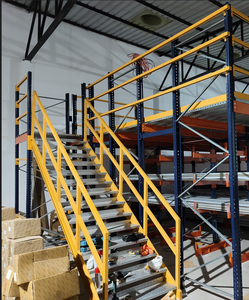
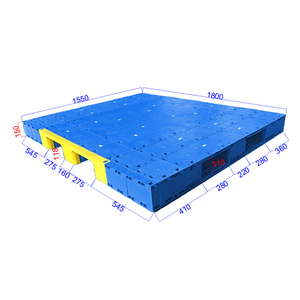
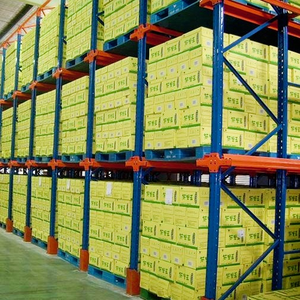
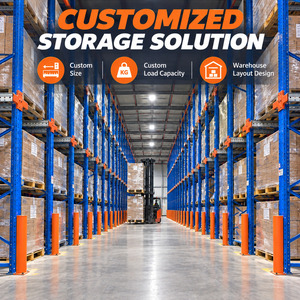
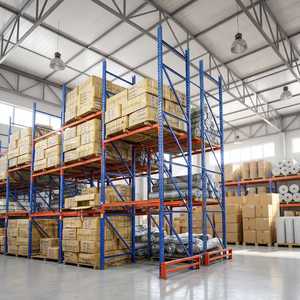
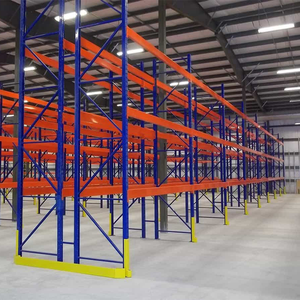
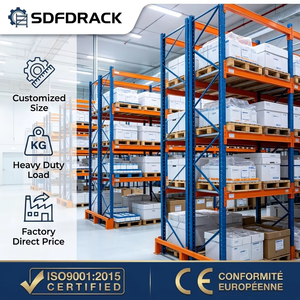
In modern global logistics and supply chain management, land acquisition and facility expansion represent immense capital expenditures. As industrial real estate rates accelerate globally, enterprise warehouse operators must extract maximum volumetric density from existing building footprints. Modern Custom OEM High Density Pallet Racking Systems provide the definitive structural engineering path to multiply vertical pallet capacity by 60% to 85% without expanding building footprints.
As a global OEM manufacturing pioneer and specialized exporter, our engineering teams deploy structural steel cold-formed profiles (Q235B grade) and hot-rolled structural channels (Q355B grade) designed to comply with rigorous international codes including ANSI MH16.1 (RMI), European EN 15512, and Australian AS 4084 standards. This engineering white paper presents an in-depth technical examination of high-density storage modalities, material integrity, custom OEM fabrication workflows, and future trends driving automated warehousing.
Roll-formed boltless tubular racking delivers unparalleled speed of installation and height flexibility for light-to-medium selective environments. Conversely, hot-rolled structural steel channel racking (SK3000 class) provides maximum impact resistance against forklift collisions, indispensable for fast-paced cold storage environments operating down to -30°C.
Selecting the optimal racking system requires a precise matrix calculation involving SKU diversity, inventory rotation velocity (FIFO vs. LIFO), floor slab load-bearing thresholds, and material handling equipment (MHE) geometry. Below are the primary high-density configurations engineered in our manufacturing facility:
Eliminating internal service aisles, forklift trucks enter directly into structural storage lanes. Configured for Last-In, First-Out (LIFO) or First-In, First-Out (FIFO) bulk storage of identical SKUs. Yields up to 75% higher space density than conventional selective systems.
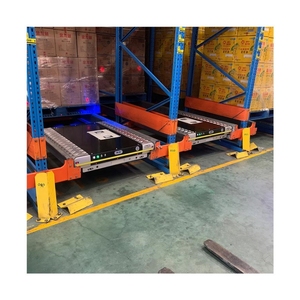
Integrates semi-automated self-powered shuttle cars within storage channels. Eliminates forklift driving into lanes, dramatically reducing structural impact damage while optimizing cycle times and storage depth up to 40+ pallets deep.
Pushback systems utilize nested floating carts on inclined rails (2 to 6 pallets deep LIFO). Pallet flow utilizes precision brake rollers and gravity tracks for automatic FIFO stock rotation, perfect for perishable goods and pharmaceutical staging.
To assist procurement managers, structural engineers, and facility designers in evaluating high-density storage solutions, the following cross-comparison outlines operational parameters across system architectures:
| Racking Architecture | Storage Density | SKU Selectivity | Rotation Logic | Forklift Impact Risk | Ideal Application |
|---|---|---|---|---|---|
| Selective Pallet Rack | Standard (40-50%) | 100% Direct Access | FIFO / LIFO | Moderate | High SKU count, FMCG hubs |
| Drive-In / Drive-Through | High (65-75%) | Low (Per Lane) | LIFO (Drive-In) / FIFO | High (Forklift in lane) | Cold storage, homogeneous stock |
| Radio Shuttle System | Ultra-High (80-88%) | Medium (Per Lane) | FIFO / LIFO Automated | Very Low (Shuttle inside) | Deep cold stores, automated DCs |
| Pushback Cart System | High (60-70%) | Medium (Per Level) | LIFO Gravity-Fed | Low | Medium-velocity bulk storage |
| Pallet Flow (Gravity) | Ultra-High (75-85%) | Low-Medium | Strict FIFO Flow | Low | Perishables, expiry-sensitive items |
As a dedicated manufacturer and global exporter, our state-of-the-art production base spans automated continuous roll-forming lines, robotic CNC welding stations, and zero-emission electrostatic powder coating lines. We offer complete original equipment manufacturing (OEM) and custom design manufacturing (ODM) to tailor structural racking to exact customer specifications:
We source certified hot-rolled coil steel (Q235B, Q355B equivalent to ASTM A36 and Grade 50) guaranteeing minimum yield strengths up to 355 MPa. For seismic zones (Category A through F), structural upright columns are engineered with teardrop or slotted profiles reinforced by internal stiffening cores.
Storage systems installed in cold rooms or humid coastal environments undergo rigorous surface pretreatment (phosphating acid washing) followed by a 80–120 micron epoxy-polyester powder coating cured at 200°C. Hot-dip galvanization (HDG) conforming to ISO 1461 is applied for deep-freeze (-30°C) pharmaceutical and agricultural storage applications to prevent micro-fissuring and rust migration.
Over 70% of rack failures result from lower upright forklift strikes. Our OEM designs incorporate heavy-duty wrap-around base guards, structural anchor bolts (M16 to M20 expansion bolts), wire mesh safety decking (rated up to 2,000kg load capacity per deck), and heavy-gauge pallet stops.
The global material handling industry is undergoing a structural transition toward automation, sustainability, and data-driven warehouse optimization. Enterprise buyers and logistics architects should account for these upcoming trends over the next decade:
Traditional manual forklift racking is increasingly adapted to mesh with Autonomous Mobile Robots (AMRs) and Automated Guided Vehicles (AGVs). High-density drive-in and shuttle racks are manufactured with ultra-tight geometric tolerances (+/- 1.5mm deflection allowance) to allow optical laser sensors on AGV forks to position pallets without human intervention.
Global supply chain decarbonization mandates that material handling hardware reduce embodied carbon. Our modern manufacturing processes utilize 100% recyclable steel alloys and solvent-free, heavy-metal-free powder coatings that release zero Volatile Organic Compounds (VOCs) during thermosetting.
Future high-density racking installations will integrate micro-electromechanical strain sensors within key load-bearing uprights. These sensors continuously transmit strain, tilt, and vibrational impact data to warehouse management software (WMS), alerting safety engineers to unseen structural fatigue before catastrophic failure occurs.
Clear engineering and logistical guidance for global importers, supply chain consultants, and facility managers.
To produce a compliant engineering drawing and quotation, we require: (1) Pallet footprint dimensions (Width x Depth x Height including cargo), (2) Maximum pallet weight, (3) Clear height under building roof joists, (4) Concrete floor slab thickness and compressive strength, (5) Forklift model, turning radius, and maximum reach height, and (6) Local seismic acceleration parameters (PGA values).
Boltless tubular racking utilizes cold-rolled steel formed into closed tubular or teardrop profiles, offering quick beam height adjustment without tools. Structural steel racking uses hot-rolled structural C-channel steel assembled with grade 5 structural bolts. Structural racking provides superior resistance to forklift collisions, making it the industry standard for drive-in racks, heavy industrial storage, and high-traffic cold storage facilities.
Our storage systems are engineered and tested in accordance with American RMI (ANSI MH16.1) standards, European Standards EN 15512 / EN 15635, and Australian Standard AS 4084. Every custom project is supplied with comprehensive structural calculation reports and load capacity warning plaques.
All upright frames, beams, and support rails are bundled with protective corrugated interleaving, wrapped in waterproof stretch film, and bound with heavy-duty steel strapping. Component bundles are labeled with unique tracking barcodes matching assembly floor plans. Loose accessories (base plates, pins, bolts) are packed in reinforced wooden export crates to prevent sea-freight moisture corrosion and loss during container transit.
Automated Radio Shuttle Racking and Drive-In Racking systems deliver the maximum volumetric space utilization (up to 85% of total warehouse volume). Radio Shuttle systems are generally preferred for modern facilities because they eliminate forklift entry into storage lanes, delivering faster cycle speeds, lower maintenance costs, and superior worker safety compared to traditional drive-in racks.
Delivering end-to-end structural engineering, rigorous material testing, and seamless international container delivery.
Finite Element Analysis (FEA) computer modeling combined with physical destructive load testing guarantees absolute structural integrity under full design capacity.
Tailored upright pitch, custom beam connector hooks, special RAL powder coating shades, and custom branding for system integrators and distributors.
Decades of container optimization experience ensure maximum cube utilization per 40ft High Cube container, reducing per-unit sea freight transit costs.
Contact our senior structural engineering team to receive a complimentary floor plan CAD layout, volumetric density analysis, and direct OEM factory quote.
Send an Inquiry