


Engineered to international design specifications (ANSI MH16.1 / RMI, EN 15512, AS 4084). Select a component configuration below to initiate customized engineering assistance.
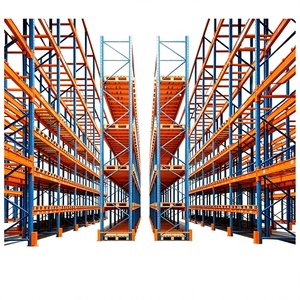
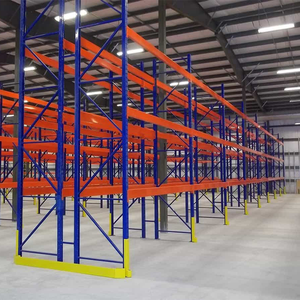
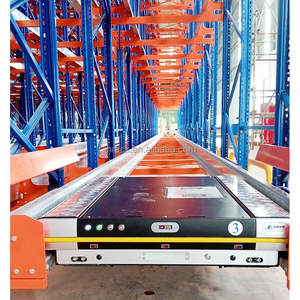
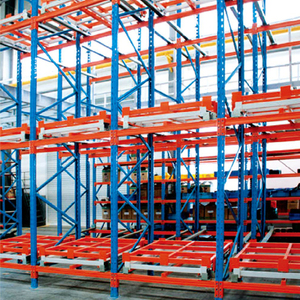
A rigorous examination of gravity dynamic lanes, structural safety margins, brake controller thermodynamics, and operational throughput maximization.
In modern industrial logistics, static storage configurations often fail to balance volume density with inventory velocity. As a premier **China top pallet flow racking manufacturer & supplier**, FlexBeam Warehouse Equipment Co., Ltd. custom engineers dynamic gravity flow rack systems designed specifically to unlock up to **85% higher spatial utilization** while strictly enforcing First-In, First-Out (FIFO) stock rotation.
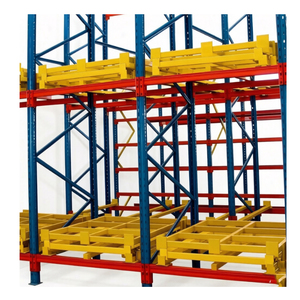
Core Engineering Principle: Pallet Flow Racking utilizes inclined wheel or roller tracks set at a precise 3% to 4% pitch gradient. Pallets loaded at the higher charge end slide seamlessly down under controlled gravitational velocity toward the discharge face, equipped with speed controllers and safety separators to eliminate kinetic impact damage.
The primary design challenge in deep-lane pallet flow systems (ranging from 2 to over 20 pallets deep) lies in controlling acceleration caused by gravity ($F_g = m \cdot g \cdot \sin\theta$). Without mechanical intervention, heavy unit loads (up to 1,500 kg per pallet) accumulate dangerous momentum. Our systems incorporate proprietary indirect magnetic braking rollers and centrifugal speed controllers spaced at calculated intervals along the lane track.
These brake rollers restrict terminal pallet velocity to a safe operational speed of 0.2 m/s to 0.3 m/s. By converting excessive kinetic energy into friction/magnetic drag, structural stress on the frame uprights, beams, and forklifts is reduced by up to 94% compared to un-braked flow channels.
When pallets reach the pick face, the cumulative line pressure exerted by trailing pallets can create severe back-pressure, making forklift extraction difficult and unsafe. To solve this, FlexBeam installs automatic pallet separators at the discharge end. These mechanical latches isolate the front pallet from the behind line of pallets by creating a 6-inch safety gap once the front pallet comes to a rest against the end stop.
Pallet separators physically lock trailing pallets back, permitting smooth, unhindered forklift extraction without binding or mast strain.
Manufactured using hot-rolled C-channel structural steel (SK3000 series) to withstand continuous heavy impact in ambient and freezer environments.
Specially engineered low-temperature synthetic lubricants and stainless steel bearings operable down to -30°C without freeze-up.
Why Tier-1 logistics centers and global manufacturing plants specify FlexBeam structural pallet flow systems for severe-duty applications.
| Performance Specification | FlexBeam Structural Steel Flow Rack (SK3000) | Standard Roll-Formed Flow Rack | Operational Impact |
|---|---|---|---|
| Steel Profile Grade | Hot-Rolled Structural Channel (Q235B / Q355B Steel) | Cold-Rolled Thin Gauge Sheet Steel | 5x Higher Torsional Rigidity: Resists severe forklift impact damage at lane entry faces. |
| Upright Column Profile | Closed Structural Tube / Structural C-Channel | Open C-Shape Roll-Formed Column | Eliminates open-section twist deformation under heavy eccentric point loads. |
| Maximum Lane Depth | Up to 25 Pallets Deep (Engineered Flow Tracks) | Typically Limited to 6 - 10 Pallets Deep | Maximum Cube Utilization: Reduces aisle requirements by up to 60%. |
| Braking & Velocity Control | Magnetic Drag / Heavy Centrifugal Brake Rollers | Standard Direct Friction Brake Rollers | Zero rubber shedding, predictable velocity control for pallets up to 1,500 kg. |
| Seismic Compliance | ANSI MH16.1 (RMI), EN 15512, AS 4084 Certified | Basic Regional Compliance | Fully engineered for global seismic zones with stamped calculation packs. |
| Finish Coating Thickness | 80-120 μm Electrostatic Thermosetting Powder / HDG | 30-50 μm Paint Finish | Superior scratch resistance, rust protection, and washdown chemical tolerance. |
How automation integration, smart IoT gravity sensors, and sustainable logistics are reshaping structural flow rack procurement globally.
Future pallet flow racks are moving toward hybrid automation interface points. Charge faces are now designed with mechanical self-centering guides and optical sensor brackets to facilitate automated placement by Autonomous Mobile Robots (AMRs) and Automated Guided Vehicles (AGVs) without human error.
Next-generation pallet flow lanes feature self-powered kinetic energy harvesting brake rollers equipped with wireless vibration and thermal sensors. Procurement teams can monitor lane health, pallet flow speeds, and potential track blockages via real-time cloud dashboards.
Combining gravity flow tracks with AS/RS crane systems allows warehouse operators to maximize vertical storage up to 40 meters. Pallet flow tracks act as dynamic buffer lanes between crane drop-off points and automated order-sorting modules.
With tightening ESG mandates globally, buyers are shifting toward zero-VOC powder coatings and circular economy structural steel alloys that offer 100% recyclability, ultra-long service life (>25 years), and reduced maintenance carbon footprints.
From initial structural slab analysis to containerized global logistics—delivering predictable quality for international procurement managers.
Every proposal begins with custom structural engineering calculations considering building height, sprinkler clearance, floor slab loading, forklift turning radius, and regional seismic zone codes.
State-of-the-art automated robotic welding lines guarantee deep weld penetration on beam connectors, base plates, and heavy-duty upright frames, eliminating manual human welding inconsistencies.
Uprights, beams, and dynamic roller tracks are systematically bundled, corner-protected, steel-strapped, and color-coded by component tag to enable fast on-site sorting and flawless installation.
Crucial engineering and commercial insights to help procurement officers and facility managers make informed decisions.
The standard pitch for plastic or sound wooden GMA pallets is typically **3.5% to 4.0% gradient** (approx. 7/16" rise per foot). For heavier pallets (>1,200 kg) or rigid steel skids, a lower gradient of **3.0%** may be specified to avoid excessive acceleration. During design, FlexBeam conducts physical friction-coefficient testing using sample pallets to determine optimal roller spacing and pitch setting.
**Pallet Flow Racking** is a dedicated **First-In, First-Out (FIFO)** system. Pallets are loaded from the rear charge aisle and picked from the front discharge aisle. **Push Back Racking** is a **Last-In, First-Out (LIFO)** system operating from a single aisle where forklifts push incoming pallets back on nested rolling carts. Pallet Flow offers deeper storage capacity (up to 20+ pallets deep), while Push Back is generally limited to 2 to 6 pallets deep per lane.
FlexBeam designs quick-drop roller tracks where speed controllers can be unbolted and replaced from beneath the lane without dismantling the main structural steel framing or adjacent roller tracks. This modular design cuts routine maintenance downtime by over 75%.
Yes. We manufacture heavy-duty cold-storage flow racking using specialized structural channel steel (Q355D grade rated for low-temperature impact toughness), low-friction synthetic lubricants, stainless steel roller bearings, and hot-dip galvanized or specialized cold-cured powder coatings designed for operating temperatures down to -30°C (-22°F).
Our engineering design team conducts finite element analysis (FEA) compliant with **ANSI MH16.1 (Specification for the Design, Testing and Utilization of Industrial Steel Storage Racks by RMI)** for North America, **EN 15512** for European markets, and **AS 4084** for Australia and New Zealand. Certified PE (Professional Engineer) structural calculations are provided upon project award.
To provide an exact layout drawing and competitive quotation, we require: (1) Pallet dimensions (W x D x H) and maximum loaded weight; (2) Pallet construction type (2-way / 4-way, wooden, plastic, steel); (3) Clear building height and floor slab specification; (4) Operating environment temperature range; (5) Forklift model, maximum lift height, and turning radius; (6) Desired total pallet storage capacity and inventory rotation method (FIFO or LIFO).
Consult directly with FlexBeam senior structural engineers. We provide CAD layouts, static calculations, and competitive OEM factory pricing within 24 hours.
Send an Inquiry