


Explore our export-grade automated pallet racking, heavy-duty shelving, and custom warehouse storage equipment.
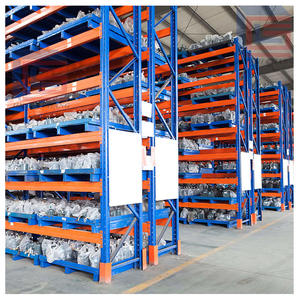
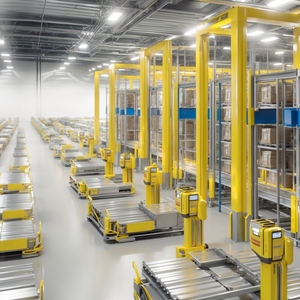
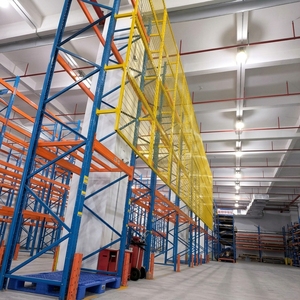
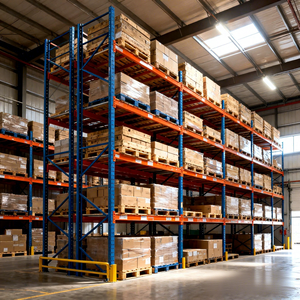
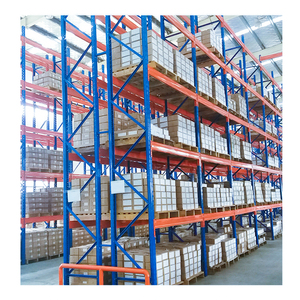
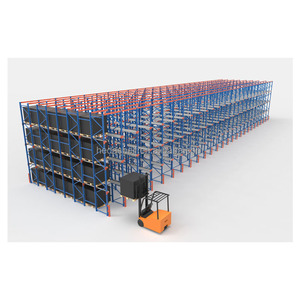
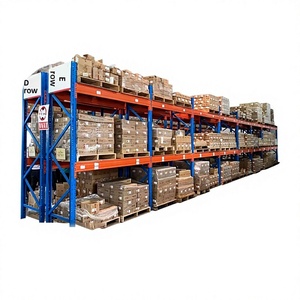
Modern supply chain architecture demands maximum floor space utilization, automated material handling, and rapid order processing throughput. The Four-Way Shuttle Racking System represents a pivotal paradigm shift in high-density automated pallet storage and retrieval systems (AS/RS). Unlike legacy two-way radio shuttles that are confined to linear, longitudinal travel inside designated channels, advanced 4-way shuttles can traverse both transverse and longitudinal rails seamlessly across an entire rack matrix.
By leveraging integrated vertical lifts (elevators) alongside intelligent Fleet Management Software (WCS), a 4-way radio shuttle storage system converts static warehouse volume into an ultra-dense, dynamically addressable automated storage grid. As top China 4-way shuttle racking system manufacturers and global exporters, engineered solutions from leading producers combine heavy-duty structural steel fabrication (such as cold-rolled SK2000 tubular profiles and SK3000 structural channels) with state-of-the-art robotic automation.
Core Architectural Advantage: 4-Way Shuttle Systems decouple storage density from throughput performance. Warehouse managers can scale storage capacity vertically by increasing rack dimensions, or scale throughput dynamically by simply adding shuttle units to the rail grid without modifying the physical steel structure.
Evaluating warehouse automation technologies requires analyzing space efficiency, operational flexibility, capital expenditure (CapEx), and total cost of ownership (TCO). The table below outlines how 4-way shuttle systems stack up against traditional pallet storage formats:
| Storage Metric / Feature | 4-Way Shuttle Racking | 2-Way Radio Shuttle | Stacker Crane AS/RS | Selective Pallet Rack |
|---|---|---|---|---|
| Storage Density Efficiency | Extreme (Up to 85% Volumetric) | High (70-75% Volumetric) | Very High (75-80%) | Low (40-45%) |
| Pallet Access Flexibility | Dynamic Random Access (FIFO/LIFO) | Channel-Dependent (LIFO/FIFO) | Direct / Fixed Aisle | 100% Immediate Direct Access |
| Redundancy & Reliability | High (Multi-Shuttle Backup) | Medium (Requires Forklift Move) | Single Point of Failure per Aisle | N/A (Manual Forklift) |
| Building Height Capability | Up to 25 Meters | Up to 12-15 Meters | Up to 40+ Meters | Up to 10-12 Meters |
| Energy Consumption Ratio | Low (Ultracapacitor/LiFePO4) | Low-Medium | High (Heavy Moving Crane) | Zero (Forklift Fuel/Battery) |
A complete 4-way shuttle racking ecosystem relies on precise mechanical tolerances, high-grade metallurgical structural steel, and robust software orchestration. Key sub-systems include:
Cold-rolled high-precision steel rails engineered with dual-running surfaces. Integrates anti-derailment lip profiles and laser-calibrated rack alignment holes.
Equipped with dual-axis drive motors, hydraulic or electromechanical pallet lifting tables, photoelectric sensor arrays, and fast-charging Lithium iron phosphate (LiFePO4) power cells.
Vertical elevators transport shuttle units and loaded pallets between storage tiers. Servomotors provide lifting speeds up to 3.0 m/s with precise leveling accuracy.
The Warehouse Control System (WCS) dispatches shuttles, optimizes traffic routing to prevent deadlocks, monitors battery levels, and syncs seamlessly with enterprise WMS/ERP.
As global supply chains face labor shortages, rising real estate costs, and aggressive ESG (Environmental, Social, and Governance) targets, 4-way shuttle technology is evolving rapidly. Procurement managers and warehouse operations leaders should track several key trends:
Modern 4-way shuttle systems are transitioning from static rule-based dispatching to machine learning routing algorithms. Intelligent WCS platforms analyze real-time inventory velocity to dynamically re-arrange pallet locations during off-peak hours (warehouse slotting optimization). High-turnover SKUs are automatically migrated closer to output vertical lifters, reducing retrieval cycle times by up to 25%.
Cold storage facilities operate under intense energy costs. The compact footprint of 4-way shuttle racking minimizes refrigerated volume, driving substantial energy savings. Modern shuttle vehicles utilize specialized low-temperature lubricants, condensation-sealed electronics, and thermal-compensated batteries engineered specifically for deep-freeze food processing and pharmaceutical cold chains.
High-density steel racking can cause RF signal attenuation and interference. Leading Chinese shuttle manufacturers are standardizing on Wi-Fi 6 and industrial 5G private networks with ultra-fast handover protocols (< 20ms roaming), ensuring zero communication drop-outs while vehicles operate deep inside multi-tier steel matrices.
Sourcing 4-way shuttle racking systems directly from top China manufacturers offers significant capital savings, but successful deployment hinges on rigorous technical procurement standards. Foreign buyers should structure their tender specs around the following critical criteria:
Referencing the established engineering heritage of FlexBeam Warehouse Equipment Co., Ltd., top-tier Chinese manufacturers bring rigorous quality control to high-density structural racking. Key manufacturing capabilities include:
FlexBeam engineers structural steel racking, boltless tubular uprights (SK2000 series), heavy-duty channel sections (SK3000 series), pushback, cantilever, and custom automated pick modules. By combining high-tensile continuous roll-forming lines with robotic welding cells, upright frames and guide rails undergo stringent dimensional inspection prior to powder coating.
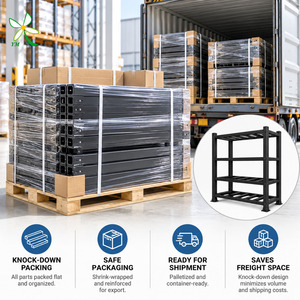
Every shuttle racking project is supplied with comprehensive load-rating documentation, certified CAD layout drawings, structural finite element analysis (FEA), and complete export containerization packaging designed to prevent transit damage during long-distance maritime freight.
Connect with our senior engineering team to receive a custom CAD layout design, structural load calculation, and factory-direct quotation for your 4-Way Shuttle Racking System.