


High-density heavy-duty cold-rolled steel structures designed for 100% immediate pallet accessibility, optimized for reach trucks, counterbalanced forklifts, and ASRS integration.
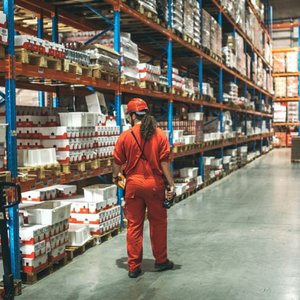
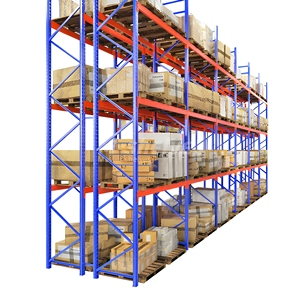
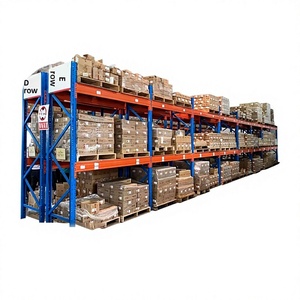
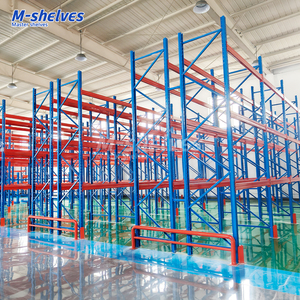
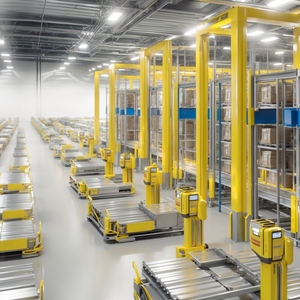
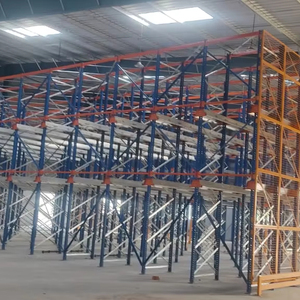
Single Selective Pallet Racking remains the structural cornerstone of modern global logistics, cold storage, e-commerce fulfillment centers, and industrial manufacturing plants. Characterized by its 100% direct-access capability for every individual pallet position, selective racking provides unmatched SKU versatility, zero-honeycombing storage efficiency, and low capital cost per pallet position compared to high-density dynamic systems.
When sourcing industrial pallet racking directly from Chinese manufacturers, procurement managers and structural engineering consultants must evaluate technical parameters beyond baseline steel pricing. Structural safety under full load capacity, elastic deformation limits, dynamic load resistance against accidental forklift impact, and anti-corrosive powder coat durability determine the system's Total Cost of Ownership (TCO) over a 20+ year lifecycle.
The structural load rating of single selective upright frames relies fundamentally on yield strength ($f_y$) and ultimate tensile strength ($f_u$) of the raw strip steel used in cold roll-forming lines. China's leading export manufacturers utilize two primary steel grades standardized under GB/T 1591 and GB/T 700:
FlexBeam and leading Chinese racking OEMs engineer upright frame columns using multi-ribbed open-section or closed tubular profiles. The introduction of 11 to 13 mechanical bending folds along the upright column profile exponentially increases the moment of inertia ($I_x, I_y$) and radius of gyration ($r$), effectively mitigating torsional-flexural buckling under combined axial loading and eccentric bending moments.
| Structural Parameter | Standard Cold-Rolled Roll-Formed | Closed Tubular (SK2000 Equivalent) | Hot-Rolled Structural C-Channel (SK3000) |
|---|---|---|---|
| Raw Steel Grade | Q235B / Q355B Strip Coil | High-Yield Structural Steel Tube | Hot-Rolled Steel Channel (ASTM A36/Q235) |
| Impact Resistance | Moderate (Requires Column Guard) | Superior (250% higher torsional resistance) | Maximum (Resists heavy forklift impact) |
| Beam Connector Type | Tear-Drop / 3-4 Hook Rivet Lock | Boltless Tear-Drop Connection | Structural Bolted Flange Plate |
| Deflection Criteria | Beam $L/200$, Upright $H/500$ | Beam $L/200$, Upright $H/600$ | Beam $L/240$, Rigid Frame Design |
| Best Applications | General DCs, FMCG, E-Commerce | High-Traffic Warehouses, Distribution | Freezers, Heavy Manufacturing, Outdoor |
According to ANSI MH16.1 (RMI specification in North America) and EN 15512 (European standard), the maximum vertical deflection ($\delta$) of load-bearing pallet beams under maximum uniformly distributed load (UDL) must strictly not exceed $\delta_{max} = \frac{L}{200}$, where $L$ represents the clear span of the step beam. Exceeding this deformation limit risks dislodging safety pins, degrading beam connector teeth, and causing operational hazards for automated reach trucks.
For seismic design categories (SDC D through F), Chinese tier-1 exporters utilize finite element analysis (FEA) software to perform response spectrum analyses. Footplate dimensions are widened, anchor bolt diameters are expanded from M10 to M16 chemical/wedge anchors, and heavy-duty horizontal and diagonal truss bracing is configured to dissipate shear forces generated during seismic ground motion.
Leveraging state-of-the-art automated manufacturing, rigorous quality control systems, and direct export logisitics for maximum global cost-competitiveness.
Equipped with high-precision 22-station automatic cold roll-forming lines, ensuring cumulative pitch errors are kept within $\pm 0.5\text{ mm}$ across 12-meter continuous upright columns.
ABB and Fanuc 6-axis robotic welding stations execute 100% full-penetration welds on beam connectors and baseplates, verified by ultrasonic and load-deflection laboratory testing.
Automated 9-stage pre-treatment washing and phosphating system followed by electrostatic thermosetting powder coating ($60\text{--}80\text{ }\mu\text{m}$ thickness), delivering salt-spray corrosion resistance up to 500 hours.
Custom heavy-duty steel channel dunnage, protective corner angles, and automated wrapping protect powder finishes during long ocean transit, maximizing container cubic utilization.
Providing comprehensive layout design, 3D BIM modeling, seismic calculation reports, and stamped engineering documentation tailored to local building codes (IBC/AS/EN).
Direct factory OEM pricing delivers 30% to 45% capital cost savings compared to Western rack brands without compromising steel thickness, load ratings, or structural safety factors.
The global warehousing and intralogistics landscape is undergoing rapid technological transformation. When planning long-term racking infrastructure investments, enterprise procurement directors must account for five emerging engineering trends:
Autonomous Guided Vehicles and Autonomous Mobile Robots demand hyper-precise bottom beam clearances and floor reflector integration. Single selective racks are now manufactured with zero-tolerance laser-punched column profiles to accommodate automated vision guidance systems.
To combat forklift collision maintenance overhead (accounting for 70% of lifecycle rack repairs), buyers are migrating from conventional open C-sections to closed square/tubular upright profiles (SK2000 style) which provide 250% greater torsional rigidity.
Smart warehouse racks are incorporating wireless strain gauge sensors and impact accelerometers within critical upright bases. Real-time telemetry alerts facility managers instantly if an impact exceeds plastic deformation thresholds or load capacity limits.
ESG compliance is driving European and North American buyers to mandate Environmental Product Declarations (EPD). Chinese mills are introducing hydrogen-reduced green steel coils and zero-VOC water-based powder coatings to satisfy Scope 3 carbon reduction targets.
With global cold storage expansion reaching record highs, specialized low-temperature alloy steels retaining high Charpy V-notch impact toughness at $-30^\circ\text{C}$ are replacing standard carbon steels to prevent brittle structural failure under freezing conditions.
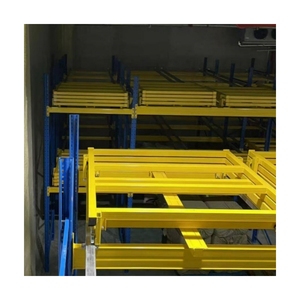
Facilitating rapid modular conversion, modern selective frame designs allow seamless retrofitting of radio shuttle rails or pushback carts into existing selective bays without replacing foundational upright columns.
Clear technical answers to help international procurement teams, project engineers, and warehouse managers make informed purchasing decisions.
Boltless roll-formed racking uses cold-rolled steel coils formed into open or tubular profiles with tear-drop or hook connectors that lock without bolts, offering cost efficiency and fast height adjustment. Structural steel pallet racking is fabricated from heavy-duty hot-rolled structural steel C-channels bolted directly together, offering extreme impact resistance and heavy load capacities ideal for freezers, outdoor environments, and rugged manufacturing plants.
To engineer an optimized layout, we require: (1) Pallet dimensions (Width x Depth x Height including cargo), (2) Maximum gross pallet weight, (3) Total clear building height and floor slab loading capacity ($\text{kN/m}^2$), (4) Forklift truck specifications (lift height, aisle turn radius, reach mechanism), (5) Operating environment temperature range, and (6) Local seismic design zone requirements.
Tier-1 Chinese rack manufacturers engineer systems in compliance with ANSI MH16.1 (Specification for the Design, Testing and Utilization of Industrial Steel Storage Racks by RMI) for the Americas, EN 15512 / EN 15635 for European markets, and AS 4084-2012 for Australia and New Zealand.
Each beam connector end-plate is equipped with an automatic spring-loaded steel safety pin or bolt lock. When the beam hook drops into the upright column teardrop/diamond hole, the safety pin snaps automatically into place, requiring a minimum vertical upward force of $1,000\text{ lbs}$ ($4.4\text{ kN}$) to dislodge, preventing accidental beam displacement during upward forklift mast movements.
Standard indoor warehouse racking features electrostatic epoxy-polyester powder coating ($60\text{--}80\text{ }\mu\text{m}$ thick) over an acid-pickled and phosphated steel base. For outdoor exposure, chemical washing environments, or high-humidity cold rooms, Hot-Dip Galvanizing (HDG) conforming to ISO 1461 ($65\text{--}85\text{ }\mu\text{m}$ zinc coating thickness) is specified for lifetime corrosion protection.
Upright frames and beams are strapped into heavy-duty bundle packs using high-tensile steel banding, cushioned by corrugated board layers and plastic edge protectors. Bundles are mounted on custom steel loading skids, allowing smooth forklift loading and unloading from $40\text{ft}$ High Cube (40HC) shipping containers without damaging the powder-coated surfaces.
Ready to optimize your warehouse storage density and structural safety? Contact our technical engineering team today for complimentary CAD floor plans, load-capacity calculations, and wholesale export pricing.
Inquire Now