


Explore our precision-engineered structural racking solutions designed for maximum cubic space utilization, cold chain resilience, and automated warehouse logistics.
As industrial real estate costs continue to escalate globally, supply chain directors, warehouse operations engineers, and procurement managers are under immense pressure to maximize pallet capacity per square meter without compromising throughput velocity or structural integrity. Selecting China’s top deep lane pallet racking manufacturer is no longer merely a purchasing decision focused on steel pricing; it is a strategic engineering alignment that dictates facility efficiency for decades.
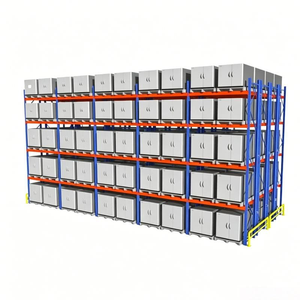
Deep lane pallet racking—encompassing automated Radio Shuttle systems, dynamic Push-Back cart matrixes, gravity-fed Pallet Flow channels, and heavy-duty Drive-In structures—represents the pinnacle of high-density warehouse storage physics. By eliminating multiple operator access aisles required by standard selective pallet rack layouts, deep-lane engineering elevates volumetric storage efficiency from a baseline of 40-50% up to an astonishing 75-88%. This whitepaper details the structural dynamics, steel metallurgy, automation integration vectors, and total cost of ownership (TCO) benchmarks necessary for enterprise procurement teams evaluating OEM export partners in China.
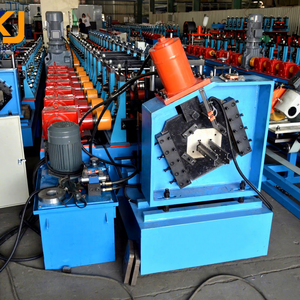
The structural longevity of high-rise deep lane racking systems hinges upon steel selection, cold-roll forming precision, and load distribution mechanics under cyclic dynamic forces. Leading Chinese racking factories leverage premium cold-rolled and hot-rolled structural steel coils (primarily Q235B and Q355B structural grade steel corresponding to ASTM A1011 SS Grade 50). The integration of Q355B micro-alloyed steel delivers a yield strength ($\sigma_y \ge 355 \text{ MPa}$), allowing upright columns to withstand intense vertical compression loads and accidental forklift impact forces while maintaining a reduced structural deadweight.
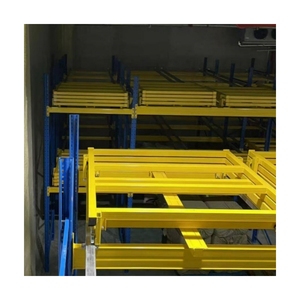
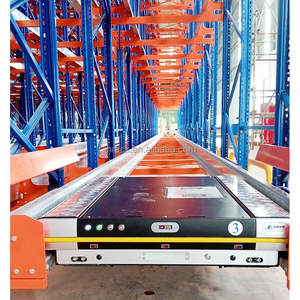
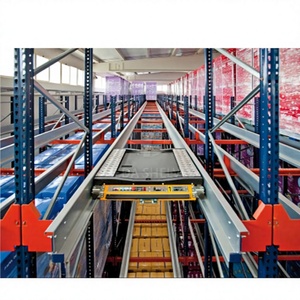
Automated deep-lane system utilizing semi-autonomous motor-driven shuttles running on guide rails within storage channels. Supports both LIFO and FIFO inventory models with channel depths exceeding 30+ pallets.
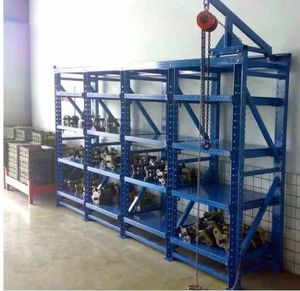
Nested cart systems on inclined structural rails. As a new pallet is loaded, it pushes preceding pallets back. When unloaded, gravity rolls pallets forward. Ideal for 2 to 6 deep LIFO selective storage.
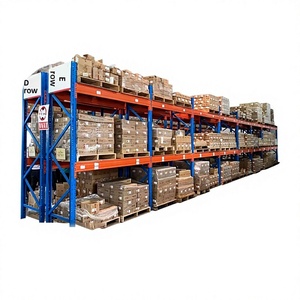
Continuous dynamic flow channels featuring heavy-duty roller beds, internal speed controllers, and separation brakes. Delivers strictly enforced FIFO turnover for high-velocity perishable consumer goods.
| Racking Architecture | Storage Density Index | SKU Selectivity Ratio | Rotation Logic | Optimal Lane Depth | Operational CAPEX |
|---|---|---|---|---|---|
| Radio Shuttle System | Ultra High (85-90%) | Medium (Per Lane) | FIFO / LIFO (Flexible) | 10 to 40+ Pallets | Automated Investment |
| Push-Back Cart Rack | High (70-75%) | High (Per Level) | Strict LIFO | 2 to 6 Pallets | Moderate CAPEX |
| Pallet Flow (Gravity) | Very High (80-85%) | Medium (Per Channel) | Strict FIFO | 5 to 20 Pallets | Mechanical Dynamic |
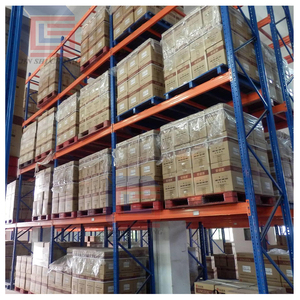
| Drive-In / Drive-Thru | High (75-80%) | Low (Per Bay) | LIFO (Drive-In) / FIFO | 5 to 10 Pallets | Cost-Effective |
| Double-Deep Selective | Moderate (60-65%) | 50% Direct Access | LIFO | 2 Pallets Deep | Low Initial Cost |
The global warehousing landscape is undergoing a massive transformation driven by rapid e-commerce expansion, cold chain infrastructure investments, and severe labor shortages across North America, Europe, and Australia. When sourcing deep lane racking systems from premier Chinese factories, procurement teams must evaluate how rack designs align with next-generation automated material handling equipment (MHE).
Traditional manual forklift entry inside Drive-In racking introduces significant structural vibration and collision risks to upright frames. Sourcing trends show a rapid transition toward Autonomous Mobile Robots (AMRs) and Automated Guided Vehicles (AGVs) operating in tandem with Radio Shuttle deep-lane systems. Modern Chinese OEM factories are engineering rack channels integrated with optical positioning targets, integrated busbar charging channels, and real-time IoT wireless monitoring sensors built directly into structural beam profiles.
Cold storage logistics hubs incur massive power costs per cubic meter of refrigerated space. Maximizing rack height up to 15-24 meters inside cold rooms requires specialized structural analysis. Modern deep lane racks manufactured in China comply with strict global seismic design codes, including ANSI MH16.1 (RMI standards in North America), EN 15512 (European Committee for Standardization), and AS 4084-2012 (Australian Racking Code). Advanced finite element analysis (FEA) software simulates seismic ground accelerations, ensuring baseplates and anchor bolt embedded depths are optimized for high-seismic zones.
Global Fortune 500 enterprises now mandate Scope 3 carbon emission accounting across their supply chains. Leading Chinese pallet racking manufacturers are adopting green steel production practices, utilizing electric arc furnace (EAF) steel with certified recycled metal content, and implementing non-VOC waterborne or powder surface finishes that eliminate toxic chemical off-gassing during installation.
Why leading global logistics brands, 3PL providers, and industrial distributors partner directly with our state-of-the-art rack manufacturing facilities in China:
Every deep-lane racking system shipped from our factory comes with structural CAD layout stamped calculations, assembly manuals, and physical load safety capacity plaques for legal compliance.
Request Factory Audit ReportExpert technical insights regarding deep lane pallet rack procurement, factory lead times, engineering parameters, and global shipping logistics.