


Industrial Engineering Excellence: CE Certified Drive-In Pallet Racks
In modern industrial logistics, floor space carries a direct operational premium. Warehouse design engineers, logistics procurement directors, and cold-chain facility managers continuously face the challenge of expanding pallet capacity without undertaking costly real-estate expansions. As a premier global manufacturer and certified exporter of industrial structural racking systems, FlexBeam provides high-density CE Certified Drive-In Pallet Racking Systems engineered specifically to solve volumetric storage bottlenecks while upholding the highest structural stability standards required by international building codes.
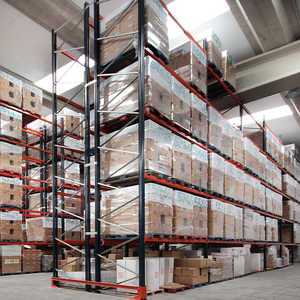
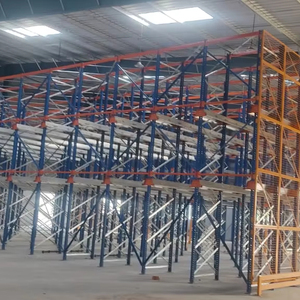
Drive-In racking operates on the Last-In, First-Out (LIFO) inventory management principle (or First-In, First-Out for dual-access Drive-Through configurations). By eliminating internal working aisles required by standard selective rack layouts, Drive-In storage allows forklifts to drive directly into the racking lanes to deposit or retrieve pallets resting on continuous horizontal support rails. This structural methodology yields up to 85% higher space utilization efficiency compared to conventional selective systems, making it the primary choice for homogeneous batch production, cold storage, pharmaceutical reserves, and seasonal product warehousing.
Structural Reliability Standard: CE Certification Compliance
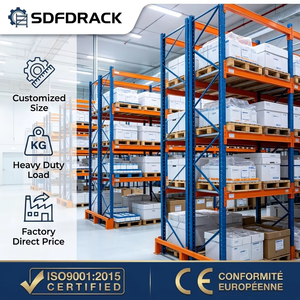
Our Drive-In racking platforms are certified under European Conformity (CE) standards including EN 15512 (Steel static storage systems - Adjustable pallet racking systems - Principles for structural design), EN 1090-1 (Execution of steel structures), and FEM 10.2.07. Every system undergoes finite element structural analysis (FEA) to verify yield points under seismic, dynamic forklift impact, and maximum vertical loading forces.
Structural Mechanics & Steel Engineering Standards
Drive-In racking systems experience fundamentally different stress patterns compared to standard selective racking. Because cross-beams are omitted within the drive-in lanes to allow forklift entry, structural rigidity must be engineered into top-tie horizontal bracing trusses, back-bracing frames (where applicable), heavy-duty cantilever support arms, and robust floor anchor points.
1. Premium Raw Material Selection (Q355B Structural Steel vs. Q235B)
Structural failure in high-density racking is almost always linked to raw material yield stress under dynamic loading. FlexBeam utilizes high-yield-strength Q355B (equivalent to S355JR structural steel) for all vertical upright columns and cantilever load arms, providing a minimum yield strength of 355 MPa. For extreme applications, hot-rolled structural channels (UPN/IPN sections) are employed to resist repeated forklift impacts in tight cold-storage lanes.
2. Heavy-Duty Cantilever Support Arms & Continuous Guide Rails
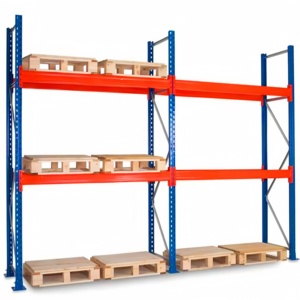
Pallets inside a Drive-In system sit directly on custom-formed cold-rolled or hot-rolled steel support rails attached to heavy-gauge cantilever arms. FlexBeam’s proprietary tapered arm connection features a 3-hook or 4-hook connector stamped with high-precision dies. This design transforms vertical load into a self-locking mechanical grip around the upright profile, eliminating torsional twisting under heavy 1,500kg+ pallet positions.
Tapered Rail Entry
Guide rails feature flared front entry lips engineered to center incoming pallets smooth and prevent accidental rail impact during high-speed forklift loading.
Impact-Resistant Cores
Lower column frames are reinforced with internal heavy-gauge steel cores or external wrap-around column protectors to absorb structural collisions from material handling equipment.
Pre-Galvanized Finish
For sub-zero food preservation environments (-30°C), all structural components are hot-dip galvanized (BS EN ISO 1461) to prevent oxidation, flaking, and cold embrittlement.
Quantitative Technical & System Comparison Matrix
Selecting the optimal warehouse storage architecture requires balancing pallet density, operational throughput speed, SKU selectivity, and capital expenditure. The table below outlines how FlexBeam’s CE Certified Drive-In systems evaluate against alternative industrial storage technologies:
| Storage System Type | Volumetric Utilization | Selectivity Rate | Inventory Rotation | Forklift Travel In-Lane | Relative CapEx / Pallet Position |
|---|---|---|---|---|---|
| Selective Pallet Racking | 35% – 45% | 100% Direct Access | FIFO / LIFO | No (External Aisle) | Base Standard ($) |
| FlexBeam Drive-In Racking | 75% – 85% | Low (Per Lane / Bay) | LIFO | Yes (Inside Lanes) | Moderate ($$) |
| Double-Deep Racking | 50% – 60% | 50% Immediate | LIFO | No (Reach Truck) | Low-Moderate ($$) |
| Pushback Rack Systems | 65% – 75% | Moderate (Per Lane) | LIFO | No (Push Cart Mechanism) | High ($$$) |
| Pallet Flow Racking | 70% – 80% | Moderate | Strict FIFO | No (Gravity Roller Deck) | Very High ($$$$) |
| Radio Shuttle Automation | 80% – 90% | High (Robot Access) | FIFO / LIFO | No (Automated Shuttle) | Premium ($$$$$) |
Global Procurement & Future Engineering Trends (2026–2030)
As industrial procurement shifts toward ESG-driven sustainability, supply chain resilience, and smart logistics, high-density Drive-In racking systems are undergoing technological evolutions. Global enterprise buyers must align their infrastructure investments with the following critical market trends:
1. Modular Hybridization to Automated Radio Shuttle Integration
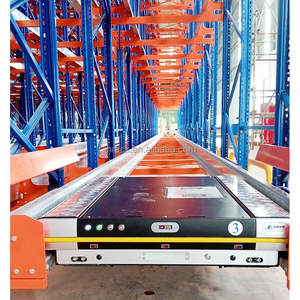
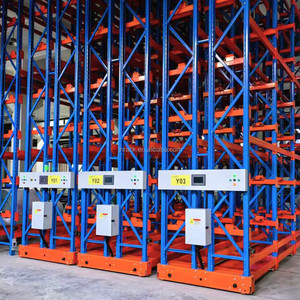
Forward-thinking supply chains are purchasing "Shuttle-Ready" Drive-In structural frames. FlexBeam engineers design custom guide-rail profiles that allow traditional forklift Drive-In lanes to be retrofitted with semi-automated radio shuttles without dismantling the upright frame structure. This future-proofs warehouse infrastructure, allowing clients to deploy robotized shuttle carts when operational budgets expand.
2. Cold-Chain Energy Optimization & Carbon Footprint Reduction
With global electricity prices rising, cold storage operators face immense operational costs to chill empty warehouse volume. Drive-In racking maximizes the density of stored goods per cubic meter, acting as a thermal mass that stabilizes internal temperatures and reduces compressor work cycles by up to 30%. High-density layout adoption directly translates to lower carbon footprint scoring for international sustainability audits.
3. IoT Structural Integrity Monitoring & Smart Floor Anchoring
Modern industrial safety protocols demand real-time telemetry. Advanced Drive-In racking systems are now equipped with low-power optical laser sensors and strain gauges integrated into the top bracing trusses. These sensors alert safety teams via automated warehouse management system (WMS) alerts if an unrecorded forklift collision impacts column verticality beyond the allowable 1/500 deflection threshold specified by EN 15512.
Procurement & Technical Engineering FAQ
Detailed technical responses to common questions raised by warehouse planners, structural engineers, and international procurement managers:
To produce a fully compliant structural CAD drawing and quotation, FlexBeam requires: (1) Pallet specifications including width, depth, height, and gross weight inclusive of goods; (2) Pallet entry directional orientation (bottom runner layout); (3) Forklift model, overall width, mast collapsed height, minimum overhead guard clearance, and maximum lift reach; (4) Warehouse clear height below roof trusses or sprinkler pipes; (5) Concrete floor slab thickness, compressive strength (e.g., C25/30), and reinforcement detailing for anchor bolt calculation; and (6) Local seismic zone ratings.
Drive-In stability relies on overhead structural engineering. We install heavy-duty horizontal top-tie bracing channels and diagonal vertical back-bracing panels across selected bays. In addition, floor anchoring utilizes chemical or expansion anchors (M12 to M20) with heavy-gauge footplates designed to distribute high shear forces caused by forklift acceleration and stopping inside the narrow lanes.
Drive-In systems feature only one entry/exit point for forklifts (LIFO - Last In, First Out), relying on a solid back-bracing wall for maximum rigidity. Drive-Through systems allow forklift entry from both the front loading aisle and the rear unloading aisle (FIFO - First In, First Out). Drive-Through systems require continuous top-truss bracing since rear diagonal bracing cannot be installed in open lanes.
Safety is built into every structural component. FlexBeam systems feature: (1) Ground-mounted heavy steel channel guide rails running the full depth of the lane to physically guide forklift tires; (2) Heavy-gauge bullnose or wrap-around upright guards at entry portals; (3) Tapered rail lead-ins to prevent fork snagging; and (4) Yellow/black high-visibility powder coat baked at 200°C for maximum visual awareness.
Export components are prepared for overseas sea-freight container transport. Uprights and beams are strapped into heavy-duty bundle units with wooden dunnage separators to prevent metal-to-metal rubbing. Small accessories, arms, baseplates, and hardware are heat-sealed in heavy plastic wrap and crated in steel-banded plywood boxes. Detailed packing list manifests and component identification stickers correspond directly with assembly installation blueprints.
Why Partner with FlexBeam Warehouse Equipment Co., Ltd.?
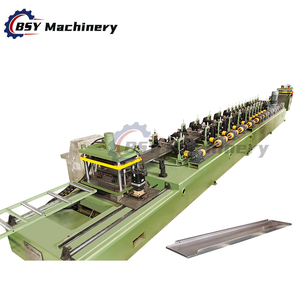
FlexBeam stands at the intersection of heavy structural engineering and modern automated warehouse manufacturing. Operating advanced CNC roll-forming production lines, automated robotic welding stations (ISO 3834 certified), and automated electrostatic powder coating lines, we deliver consistent manufacturing precision to global enterprise clients.
Our engineering department provides full structural calculation packages certified by independent third-party engineers, ensuring your installation passes strict local building municipal inspections across Europe, North America, the Middle East, and Australasia. From initial CAD space optimization to international freight forwarding and installation supervision, FlexBeam delivers predictable, high-value storage infrastructure engineered for long-term operational ROI.
Request an Engineered Layout & Project Quote
Connect directly with our senior racking structural engineers to review your warehouse floor plans, load parameters, and CE documentation requirements.
Get Catalog