Drive-In Pallet Racking can store many pallets in a compact footprint, making it useful for warehouses handling large quantities of similar goods. Forklifts enter the rack lanes to load and retrieve pallets, so layout and operating procedures matter. This system typically follows last-in, first-out access. That trade-off deserves attention.
Choosing a Chinese supplier involves more than comparing prices or photographs. Buyers should check engineering drawings, stated load capacities, steel specifications, finish options, and installation support. Ask how the supplier accounts for pallet dimensions, forklift clearances, floor conditions, and the intended number of rack levels. Request relevant project references, too. A polished brochure is not proof.
This guide looks at suppliers serving the Chinese market and the details that help distinguish a capable manufacturer from a convenient listing. It considers product range, technical communication, quality-control information, delivery coordination, and after-sales service. These checks can make comparisons more grounded, but they cannot replace a site-specific design review. The best fit depends on the goods, traffic patterns, and warehouse constraints. Even a well-designed system can disappoint if daily loading practices are overlooked. That point is easy to miss. Use the supplier shortlist as a starting point, then verify requirements with qualified warehouse professionals before making a purchase.
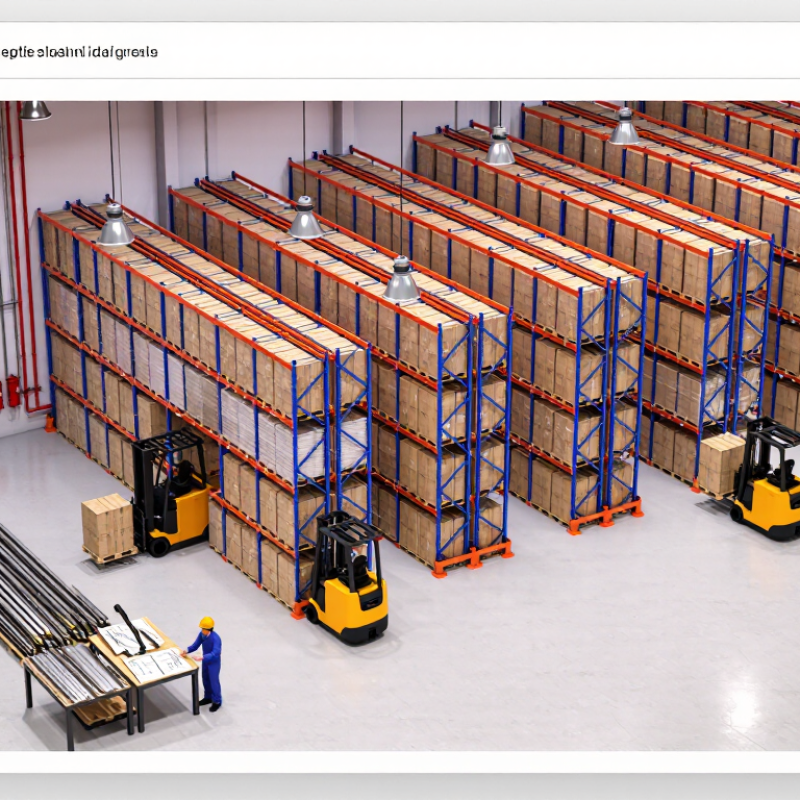
Drive-in pallet racking stores pallets in deep lanes, reducing the number of aisles needed. Upright frames support rails, and pallets rest on those rails rather than on the floor. A forklift enters the lane to place or retrieve each load.
Space is the gain. Access is the trade-off.
In a typical drive-in setup, the forklift loads pallets from the front toward the back. During unloading, the nearest pallet is removed first, so the system follows last-in, first-out storage. A drive-through arrangement can allow access from both ends, but it needs a suitable site layout and operating plan.
Pallet size, load weight, forklift turning space, and rail clearances all matter. A mismatch can cause awkward handling, or damage. It is worth checking actual pallet samples and truck dimensions before finalizing the lane design.
Tips: Keep pallets consistent and inspect them for broken boards. Train operators to enter lanes slowly and keep loads level. Don’t assume every high-density layout suits every product; frequent access may make the lost selectivity frustrating.
When comparing drive-in pallet racking suppliers in China, assess how their designs match your inventory and forklift operations. The main benefit is high storage density. Forklifts enter storage lanes, so fewer aisles are needed than with many selective-rack layouts. This can free floor space in a warehouse holding large quantities of similar products. It often works well for seasonal goods or uniform cartons and pallets. A strong fit, sometimes.
The layout has limits. Because pallets are stored several positions deep, access is less direct than in selective racking. A forklift must enter the lane to load or retrieve pallets, increasing the chance of contact with rails or uprights. This calls for trained operators and careful handling. Stock rotation can also be harder, especially when older pallets sit behind newer ones. High SKU variety may make lane assignments awkward. Check that the supplier’s design considers pallet dimensions, load weights, floor condition, and local operating practices.
Tips: Ask for a layout based on your actual pallet sizes and forklift turning clearances. Confirm rated loads and protective features in writing. If every product needs frequent, individual access, drive-in racking may not be the right trade-off.
What Are the Top Drive In Pallet Racking Suppliers in China?
How Can Chinese Drive-In Pallet Racking Suppliers Be Evaluated?
Evaluate suppliers by how clearly they connect rack design to your warehouse conditions. Share pallet weights, load dimensions, forklift details, aisle width, and available ceiling height. Ask for layout drawings and calculations showing upright, beam, and bracing specifications. Check whether the supplier explains load limits in writing, rather than offering a generic capacity figure. Small details matter. A few millimeters of clearance can affect forklift access and daily handling.
Tips: Request recent project references for systems with similar loads and operating conditions. Ask how steel quality, welds, coatings, and finished dimensions are inspected. Review the inspection records, warranty terms, spare-part availability, and production schedule. If a quote omits installation assumptions, ask for clarification before comparing prices.
Communication is part of the evaluation. Notice whether technical questions receive specific answers or vague reassurances. Compare the proposed design with an independent review from a qualified local engineer, especially where site conditions or applicable standards require attention. A lower quote may leave out anchoring, protective guards, or installation support. That is easy to miss. Supplier documents can also be incomplete, so verify key details rather than assuming every drawing matches the final equipment.
Use the criteria below to compare suppliers without relying on company names or unsupported rankings. The weights are a practical evaluation model; verify each item against the project specification, applicable local requirements, and documented evidence.
| Evaluation Dimension | Weight | What to Check for Drive-In Racking | Evidence to Request | Warning Signs |
|---|---|---|---|---|
| Engineering and load design | 20% | Check that the design reflects pallet dimensions and mass, forklift type, aisle and tunnel layout, bay depth, rack height, floor conditions, and applicable seismic or other project loads. Confirm that the supplier explains how load capacity is determined. | Project-specific drawings, design calculations, load tables with stated assumptions, and details of the proposed structural members and connections. | Capacity figures are provided without assumptions, calculations, or a clear description of the configuration they cover. |
| Drive-in configuration and pallet compatibility | 15% | Verify pallet entry clearances, rail spacing, support arrangement, column protection, forklift travel path, and operating clearances. Confirm that the proposed layout suits the intended last-in, first-out operating method. | Dimensioned layout and elevations, pallet and forklift interface details, and a documented review of the proposed unit loads. | The design assumes uniform pallets or forklift dimensions without checking the actual loads and handling equipment. |
| Standards and safety documentation | 15% | Ask which standards and jurisdictional requirements apply to the project. Relevant European references may include EN 15512 for adjustable pallet racking design, EN 15620 for tolerances, deformations and clearances, EN 15629 for specification, and EN 15635 for use and maintenance. | Standards list with editions and scope, design documentation, operating and inspection guidance, and any applicable test or conformity reports. | A certificate or standards claim is presented without identifying its scope, edition, issuing body, or connection to the proposed rack design. |
| Manufacturing quality and traceability | 12% | Review control of material specifications, forming and welding processes where applicable, dimensional tolerances, component identification, and inspection of finished parts. | Quality procedures, inspection records, material documentation where specified, production traceability, and sample inspection reports. | Quality claims cannot be linked to records, production batches, or identifiable components. |
| Corrosion protection and finish | 8% | Match the finish to the storage environment, including humidity, temperature, cleaning practices, and any corrosive exposure. Confirm the specified coating or finish and its inspection requirements. | Written finish specification, coating or surface inspection records where applicable, and confirmation that the finish is suitable for the intended environment. | The finish is described only as “standard” or “high quality,” with no material or coating specification. |
| Customization and design coordination | 8% | Assess the supplier’s ability to coordinate rack geometry with building columns, floor joints, fire-protection systems, lighting, conveyors, and warehouse operating requirements. | Project-specific drawings, a documented design-review process, and a clear record of assumptions and customer approvals. | Standard drawings are offered without checking site dimensions or coordination constraints. |
| Installation and inspection support | 7% | Confirm installation responsibilities, alignment and anchoring checks, handover documentation, and the availability of guidance for safe use and regular inspection. | Installation method statement, inspection checklist, handover records, and written guidance on reporting damage and arranging repairs. | Installation, inspection, or handover responsibilities are left undefined. |
| Delivery planning and communication | 7% | Check whether the proposed production and shipping schedule fits the project plan, and whether packaging, component labeling, and delivery sequencing support efficient receiving and installation. | Written schedule, packing and labeling plan, shipping terms, and a named point of contact for project coordination. | Delivery dates are given without a production plan, shipment details, or a process for managing changes. |
| Commercial clarity and after-sales support | 8% | Compare the scope of supply, exclusions, warranty terms, spare-part availability, response arrangements, and the process for handling design or product issues. | Itemized quotation, written warranty, clearly defined exclusions, spare-parts information, and documented support terms. | Important exclusions, warranty limits, or service responsibilities are unclear or provided only verbally. |
| Total evaluation weight | 100% | Use the same project requirements and evidence standard for every supplier being compared. | ||
Suggested scoring: Rate each dimension from 1 to 5, where 1 means inadequate or unsupported and 5 means fully documented and suitable for the project. Multiply each rating by its weight to calculate a weighted comparison. Treat this as a screening tool—not as a substitute for project-specific engineering review or verification of applicable regulations.
China’s drive-in racking market serves warehouses handling many pallets of the same product. The China Federation of Logistics and Purchasing reported total social logistics value of RMB 352.4 trillion in 2023, up 5.2% year on year. That broad measure signals sustained logistics activity, but it does not isolate demand for racking. Buyers should treat it as context, not proof of supplier performance.
Notable suppliers generally fall into three groups: established domestic rack manufacturers, warehouse-system integrators, and regional fabricators. Manufacturers may offer in-house design, production, and installation; integrators can coordinate racks with forklifts, software, and warehouse layouts. Regional firms may respond quickly, though their engineering and service coverage can vary. No category is automatically best. Check load calculations, steel specifications, upright protection, and references from comparable cold-storage or high-throughput sites.
Ask each candidate for a site-specific layout and a clear explanation of operating limits. Drive-in systems reduce aisle space, but forklifts enter the rack lanes, so impact protection and operating discipline matter. Request drawings, inspection guidance, and local after-sales arrangements in writing. One caveat: public reports rarely rank Chinese suppliers by verified drive-in installations. A polished catalogue is useful, but not enough.
Choosing a Chinese drive-in pallet racking supplier means checking more than price and delivery time. Ask for project-specific drawings, load calculations, steel specifications, and installation instructions. Confirm that the design accounts for pallet dimensions, forklift clearance, floor conditions, and the number of pallets stored deep in each lane. Request references for comparable installations and inspect welds, upright frames, and surface finish on a sample. A polished brochure proves little.
Supplier capability matters as warehouses adopt more technology. MHI’s 2024 Annual Industry Report found that 55% of surveyed companies planned to spend more than $1 million on supply-chain technology over the following two years. This does not prove a rack supplier is qualified, but it makes compatibility worth checking. Ask whether rack layout, forklift access, and any planned automation have been reviewed together. Compare calculations against recognized guidance, such as ANSI MH16.1, and have a qualified local engineer review the design. A low quote can still be costly if the load assumptions are vague.
Tips: Request a written warranty, production schedule, and spare-parts list. Ask the supplier to explain one design choice in plain language. If answers stay general, pause. I would also check whether quoted capacity changes when pallet loads or beam levels change; buyers sometimes overlook that detail.
It stores pallets in deep lanes, reducing the space needed for aisles. Upright frames support rails, and pallets rest on them. Simple, but dense.
A forklift enters from the front and places pallets toward the back. During unloading, the nearest pallet comes out first. This is last-in, first-out storage.
Drive-through layouts can allow forklift access from both ends. They need a suitable site layout and clear operating plan. Details matter.
Check pallet size, load weight, forklift turning space, and rail clearances. Test actual pallets and truck dimensions before finalizing the design. Small mismatches matter.
It can suit warehouses storing many pallets of the same product. Frequent access to individual pallets may make reduced selectivity frustrating. Not every product fits.
Inspect pallets for broken boards, keep loads level, and enter lanes slowly. Training helps. It cannot replace careful driving.
Options include domestic rack manufacturers, warehouse-system integrators, and regional fabricators. Their engineering, installation, and service coverage can vary. No category is automatically best.
Request site-specific layouts, load calculations, steel specifications, upright protection details, and comparable project references. Get inspection guidance and after-sales arrangements in writing.
No. A broad logistics figure shows market context, not racking demand or supplier performance. Public reports rarely verify installation rankings. A catalogue alone is not enough.
Drive-In Pallet Racking is a high-density storage system in which forklifts enter storage lanes to place and retrieve pallets. By reducing the number of aisles, it can make better use of available warehouse space, especially when many pallets contain the same product. Its lane-based design typically prioritizes last-in, first-out access, however, so it may offer less selectivity and flexibility than systems designed for direct access to every pallet.
When comparing Chinese suppliers, buyers should assess product quality, structural design, load capacity, manufacturing consistency, customization options, delivery capability, and after-sales support. It is also important to provide clear information about pallet sizes, forklift specifications, inventory patterns, and warehouse conditions before requesting a proposal. The right supplier should be able to explain how the system fits these requirements, identify operational trade-offs, and provide practical support from planning through installation.