Deep Lane Pallet Racking can turn a narrow aisle into a high-capacity storage zone. It is not automatically the right choice. Pallet dimensions, product rotation, forklift clearance, and inventory accuracy all shape the result. A system that stores more pallets but slows retrieval may create a different bottleneck.
The 2024 MHI Annual Industry Report found that 55% of surveyed supply-chain professionals planned to increase technology investment over the following two years. MHI CEO John Paxton is among the industry leaders discussing this shift toward more technology-enabled operations. For rack selection, one practical question deserves attention: “Can the next pallet be reached when operations need it?” This is a design prompt, not a verified quotation from Paxton. The distinction matters; storage density should be judged against actual workflow, not a headline capacity claim.
This guide compares seven Deep Lane Pallet Racking systems for warehouse teams weighing density against access. It considers drive-in, push-back, pallet-flow, and other deep-lane configurations, alongside their operating trade-offs. Picture a forklift entering a drive-in lane, or a pallet moving forward under gravity. Those details change replenishment, picking, and safety procedures. The best fit depends on SKU count, rotation patterns, and handling equipment. No rack type solves every layout. A careful site review is still essential.
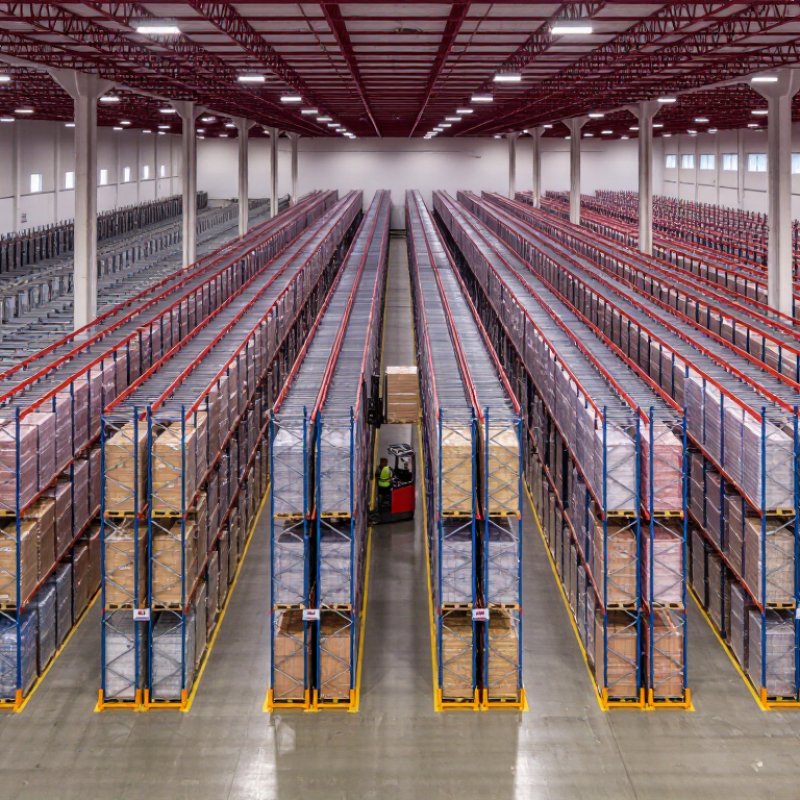
Deep-lane pallet racking stores multiple pallets one behind another in each lane, rather than placing every pallet beside an aisle. A forklift enters the lane or loads travel along support rails, depending on the system design. The result is less aisle space and more storage positions within the same warehouse footprint. That matters.
Access works differently from single-deep racks. In drive-in layouts, pallets are commonly loaded and retrieved from the same end, so the last pallet in is usually the first one out. Drive-through layouts allow access from both ends and can support first-in, first-out handling when operations are managed accordingly. Pallet-flow systems use rollers to move loads forward, but require suitable pallets and careful setup.
The density has a trade-off. A pallet near the lane entrance can block access to stock behind it, so deep lanes work best when products move in predictable batches. Before selecting a layout, measure pallet sizes and loads, check forklift clearance, and confirm the floor can support the planned weight. Small differences matter. Mixed pallet dimensions may create gaps, friction, or awkward retrieval. Deep storage can look efficient on a drawing, yet feel less so during a busy shift.
7 Best Deep Lane Pallet Racking Systems for Warehouses
Drive-in racks store pallets several positions deep, with forklifts entering the lanes. They suit high-volume storage with few product types, but usually operate on a last-in, first-out basis. Drive-through racks allow access from both ends, supporting first-in, first-out rotation when warehouse processes maintain that flow. They need access aisles at both ends. That costs space.
Push-back racks use nested carts, so forklifts load pallets from one face while earlier pallets move deeper. They offer selectivity between single-deep and drive-in layouts, but typically use last-in, first-out handling. Pallet-flow racks use gravity rollers to move loads toward the picking face, making them useful for first-in, first-out stock rotation. Roller maintenance and pallet condition matter. MHI’s 2024 Annual Industry Report found that 55% of supply chain leaders planned to increase technology investment. That supports careful evaluation, not automatic automation: a rack’s operating fit still matters more than novelty.
Tips: Map pallet dimensions, load weights, SKU counts, and daily picks before choosing a system. Test a loaded lane with your actual forklift and pallets. It can reveal awkward clearances that a drawing misses. Compare replenishment time and access to older stock, too.
| System | Pallet Access & Rotation | Typical Lane Depth | Storage Density | Equipment & Operating Needs | Best Suited For | Main Trade-Off |
|---|---|---|---|---|---|---|
| Drive-In Pallet Racking | One aisle serves both loading and retrieval. Typically LIFO: the last pallet loaded is retrieved first. | Often several pallet positions deep; the practical depth depends on the building, pallet load, and lift-truck operation. | High: fewer access aisles are needed than with selective racking. | Lift trucks enter the rack lanes and travel on guide rails or the floor, depending on the design. | High-volume storage of a limited number of product types, especially where batches can be stored together. | Reduced selectivity; trucks must enter the rack, so load damage and operating speed need careful management. |
| Drive-Through Pallet Racking | Access is available from both ends. It can support FIFO when loading and retrieval are managed from opposite ends. | Several pallet positions deep; lane length is set by the operation and equipment. | High: both ends of the lane are accessible, with fewer aisles than selective layouts. | Lift trucks enter the lanes; the layout needs clear loading and retrieval ends. | Products with regular replenishment and dispatch, and operations that benefit from first-in, first-out rotation. | Requires disciplined lane management and enough space at both ends for truck access. |
| Push-Back Pallet Racking | Pallets are loaded and retrieved from the same aisle. Typically LIFO within each lane. | Commonly configured for a few pallets deep; the number of positions depends on the cart and rack design. | High: multiple pallets are stored behind each aisle-facing position. | A lift truck places each pallet on a nested cart and pushes it back; the next pallet moves forward as a load is removed. | Several pallets per product with frequent access from a single aisle and no strict FIFO requirement. | Not suitable for strict FIFO; carts and moving loads require compatible pallets and careful operation. |
| Pallet-Flow (Gravity-Flow) Racking | Pallets enter at the loading end and move by gravity toward the retrieval end. Typically FIFO. | Can be designed for multiple pallet positions per lane; depth depends on load, roller or wheel design, and flow requirements. | Very high: storage and retrieval aisles can be separated, reducing aisle requirements. | Uses inclined roller or wheel tracks with flow-control and braking components selected for the loads. | High-throughput, date-sensitive, or batch-based inventory that benefits from FIFO rotation. | Higher system complexity and cost than static racks; pallets must be suitable for the flow equipment. |
| Pallet Shuttle Racking | A powered shuttle moves pallets within deep lanes. FIFO or LIFO operation depends on the system layout and workflow. | Designed for deep lanes, with lane length and shuttle capacity determined by the project. | Very high: fewer aisles are needed, and trucks generally remain at the lane entrance. | Requires compatible shuttles, charging or power arrangements, controls, and trained operators. | High-density storage of many pallets per SKU, especially where reducing truck travel into racks is valuable. | Higher investment and added reliance on equipment, controls, and maintenance than static systems. |
| Mobile Pallet Racking | Rack rows move on powered bases to open an access aisle at the required location; pallets are accessed from the opened aisle. | Rows are typically arranged as single- or double-deep rack; storage depth depends on the layout. | High: several fixed aisles can be replaced by a smaller number of movable access aisles. | Needs powered mobile bases, safety controls, suitable floor conditions, and aisle-access procedures. | Warehouses needing high storage density while retaining access to a broad range of pallet loads. | Access is sequential because an aisle must be opened; retrieval can be slower than in layouts with permanent aisles. |
| Double-Deep Pallet Racking | Two pallets are stored one behind the other. The rear pallet is accessed after the front pallet is moved. | Two pallet positions deep. | Moderate to high: fewer aisles may be needed than with single-deep selective racking. | Usually requires a reach truck or another lift truck designed to access the second position. | Operations seeking a density increase while retaining access to individual rack bays and a moderate range of SKUs. | Lower selectivity than single-deep racking; rear loads are not directly accessible while front positions are occupied. |
Deep-lane pallet racking can increase storage density by reducing the number of aisles between rack rows. More floor space then holds pallets instead of travel lanes. Some warehouse layouts may gain capacity by up to 75%, but that figure is not guaranteed. It depends on the existing layout, pallet dimensions, rack depth, and operating needs.
Measure the usable floor area before comparing systems. Count pallet positions, not just rack bays, and include space for turning, staging, and access to exits. Check carefully. A dense design can store more inventory, yet make individual pallets slower to reach. Last-in, first-out access also suits some products better than mixed, fast-moving stock. That distinction matters.
Forklift type and operator visibility affect how safely and smoothly pallets move through deep lanes. Review load weights, pallet condition, and the space needed for maintenance and inspections. Small details matter. A damaged pallet deep inside a lane may be harder to remove than one on an open aisle. Honestly, capacity estimates can look impressive on paper; a layout test using real pallet sizes and traffic patterns is more dependable. Compare the added positions with the daily effort required to retrieve them.
Deep lane racking trades selective access for dense pallet storage, so match the loading method to product rotation. LIFO systems load and retrieve pallets from the same aisle. They suit stable, non-perishable SKUs with several pallets per item. FIFO systems load from one side and retrieve from the other, helping older stock leave first. They fit dated goods and products with strict rotation needs. Check that the building layout supports access from both ends before choosing FIFO.
The CSCMP 2024 State of Logistics report estimates U.S. business logistics costs reached $2.3 trillion in 2023, or 8.7% of GDP. That figure covers the wider logistics sector, not racking alone, but it underscores why storage and handling decisions deserve close review. Deep lanes can increase storage density, yet a slow-moving SKU may occupy a valuable position for too long. Small detail. Hard lesson. Review actual SKU turnover and expiry patterns, not just average pallet counts. A clean spreadsheet can still hide seasonal spikes.
Tips: Group fast-moving, date-sensitive SKUs in FIFO lanes where practical. Reserve LIFO lanes for uniform, non-expiring stock with predictable demand. Confirm pallet dimensions, load weights, and replenishment routes with a qualified warehouse designer. Run a small pilot first; lane depth and daily traffic may behave differently than expected.
Deep lane pallet racking concentrates several pallet positions behind one another, so the design must reflect the actual storage pattern. Before installation, compare the rack calculations and drawings with the applicable edition of ANSI MH16.1. Check upright capacity, beam connections, bracing, base plates, and anchorage. Small changes matter. A heavier pallet or altered lane depth can change the load path.
The review should use real operating details, not just a maximum-load figure. Record pallet weights, dimensions, lane depth, lift-truck type, and expected impact exposure. Confirm that the floor and anchors can support the planned loads. OSHA 1910.176(b) requires stored materials to remain stable and secure against sliding or collapse. In deep lanes, that means checking how pallets are placed, supported, and retrieved—not merely whether the rack looks sturdy.
Keep approved load limits visible, and train operators to report bent uprights, loose anchors, or damaged beams promptly. A qualified rack design professional should assess structural questions and any proposed changes. Paperwork can miss what a busy aisle reveals. I would also recheck the design after changing pallet sizes; that step is easy to overlook, and it can expose assumptions that were never quite right.
The bars show example pallet positions deep for common layouts, not standardized system limits or engineered capacities. Actual lane depth depends on the rack design, pallets, equipment, loads, and operating method. Before installation, verify the rack design against the applicable edition of ANSI MH16.1 and ensure stored materials are stable and secured against sliding or collapse as required by OSHA 1910.176(b).
Forklifts enter deep lanes to place and retrieve pallets. It suits high-volume storage with few product types. Access is usually last-in, first-out.
Forklifts can access lanes from both ends, supporting first-in, first-out rotation. The layout needs an aisle at each end. That takes space.
Nested carts move earlier pallets deeper as new pallets enter from one face. It offers more selectivity than drive-in storage, but usually follows last-in, first-out handling.
Gravity rollers move pallets toward the picking face, helping maintain first-in, first-out access. Keep rollers maintained and check pallet condition. Damaged pallets can disrupt movement.
Some layouts may gain up to 75%, but that result is not guaranteed. Rack depth, pallet sizes, aisle space, and daily operations affect capacity. Measure real pallet positions.
Record pallet dimensions, weights, SKU counts, and daily picks. Test a loaded lane with the actual forklift. Awkward clearances can surprise you.
Check rack capacity, bracing, anchors, floor support, and visible load limits. Train operators to report bent uprights or damaged beams. Recheck the design when pallet sizes change; I might be overlooking something, but that step seems easy to miss.
Deep Lane Pallet Racking stores multiple pallets in a single lane, allowing warehouses to use floor space and vertical capacity more efficiently than many conventional layouts. This guide compares four common designs: drive-in, drive-through, push-back, and pallet-flow racking. Each offers a different balance of storage density, access, and inventory movement. Deep-lane configurations can increase storage capacity by up to 75%, depending on the warehouse layout and system selected.
Choosing the right system depends on SKU turnover and stock-rotation needs. LIFO access may suit slower-moving inventory, while FIFO systems can help manage products that require earlier stock to be picked first. Before installation, evaluate load requirements, forklift operation, and site conditions, and verify the rack design against applicable ANSI MH16.1 and OSHA 1910.176(b) requirements.