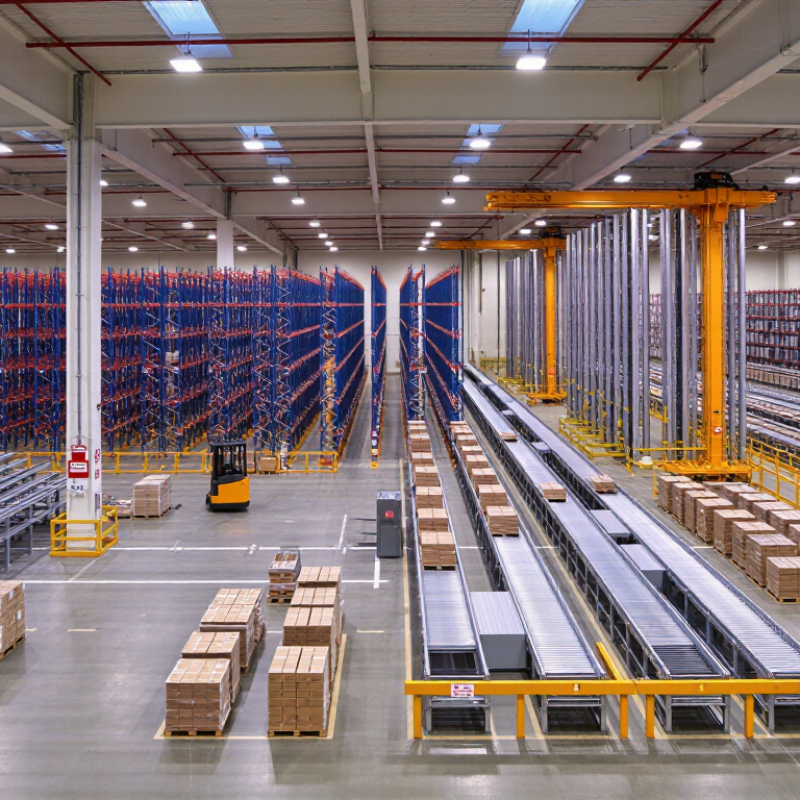
| Single-Deep AS/RS Pallet Racking |
One pallet position deep, served by an automated storage and retrieval crane. |
500–1,500 kg per pallet position, subject to rack design and floor loading. |
8–30 m, depending on building height, crane type, and local safety requirements. |
High; vertical space is used efficiently and aisle count can be reduced. |
Excellent for FIFO and controlled inventory access. |
20–40 pallets/hour per crane system is commonly achievable with suitable infeed, outfeed, and control design. |
High-volume distribution centers, manufacturing warehouses, and temperature-controlled facilities. |
Requires accurate pallet dimensions, stable loads, fire protection coordination, automation controls, and a higher initial investment. |
| Double-Deep AS/RS Pallet Racking |
Two pallet positions deep, normally accessed by a reach mechanism or double-deep crane. |
600–1,500 kg per pallet position. |
8–25 m in many industrial installations. |
Very high; stores more pallets per aisle than single-deep layouts. |
Good for medium-SKU inventories with repeated pallet movements. |
Approximately 20–40 pallets/hour per crane, depending on travel distance, lift height, and storage strategy. |
Large-volume storage where higher density is more important than direct access to every pallet. |
Some rear pallet positions can be less accessible; lane sequencing and inventory management are important. |
| Automated Pallet Shuttle Racking |
Deep-lane racking with motorized shuttles transferring pallets inside storage channels. |
500–1,500 kg per pallet position. |
Usually 6–15 m, with higher systems possible after engineering review. |
Very high; deep lanes reduce aisles and improve cube utilization. |
FIFO or LIFO, depending on lane arrangement and shuttle configuration. |
Often 20–40 pallets/hour per lane or shuttle station; total system capacity depends on the number of shuttles and lifts. |
Cold storage, beverage, food, wholesale, and high-density buffer storage. |
Best performance requires standardized pallets, reliable battery charging, lane discipline, and suitable temperature-rated equipment where needed. |
| Very Narrow Aisle Pallet Racking |
Single-deep selective rack served by specialized turret or articulated trucks. |
500–1,500 kg per pallet position. |
6–15 m for many warehouse layouts. |
High; aisle width can be reduced to roughly 1.5–2.0 m with compatible equipment and controls. |
Excellent; direct access supports FIFO and high SKU variety. |
Typically 15–35 pallet movements/hour per truck, depending on travel distance and operator or automation level. |
High-SKU warehouses requiring direct access and good vertical utilization. |
Requires very flat floors, guided travel or positioning systems, specialized trucks, and careful pedestrian separation. |
| Selective Adjustable Pallet Racking |
Individual pallet locations accessed from standard forklift aisles. |
500–2,000 kg per pallet position, based on beam size, frame design, and load distribution. |
3–12 m in common applications. |
Moderate; provides direct access but uses more aisle space than dense systems. |
Excellent for FIFO, mixed SKUs, and frequent replenishment. |
Approximately 15–35 pallets/hour per forklift in well-organized operations. |
General warehouses, retail distribution, spare parts, and mixed-product storage. |
Usually the simplest and most flexible option, but it has lower storage density and higher forklift aisle requirements. |
| Drive-In or Drive-Through Pallet Racking |
Forklifts enter structural storage lanes to place pallets on continuous rails. |
500–1,500 kg per pallet position. |
4–10 m in many facilities. |
Very high; minimizes aisles and is suitable for deep-lane storage. |
LIFO for drive-in layouts; FIFO is possible with drive-through access. |
Usually 10–25 pallet movements/hour per forklift, depending on lane depth and handling discipline. |
High-volume, low-SKU products with relatively uniform pallet loads. |
Lower selectivity, greater risk of rack impact, and stricter requirements for pallet quality and forklift operation. |
| Push-Back or Pallet Flow Racking |
Push-back uses inclined carts; pallet flow uses rollers for controlled pallet movement. |
500–1,500 kg per pallet position. |
4–10 m in typical heavy-duty installations. |
High; storage lanes are deeper than selective rack while maintaining faster access than drive-in. |
Push-back generally operates LIFO; pallet flow is designed for FIFO. |
Approximately 15–30 pallets/hour per forklift or lane, depending on replenishment and picking patterns. |
Food and beverage, finished goods, distribution buffers, and products with batch or date control. |
Requires compatible pallets, correctly engineered lane slopes or rollers, and regular inspection of brakes, wheels, and guides. |